Most visitors come to the Uffizi Gallery for its Renaissance paintings, but the museum also has an excellent and often overlooked collection of classical sculptures. These works, mainly Roman copies of Greek originals, are displayed throughout the gallery and add an important dimension to the visit.
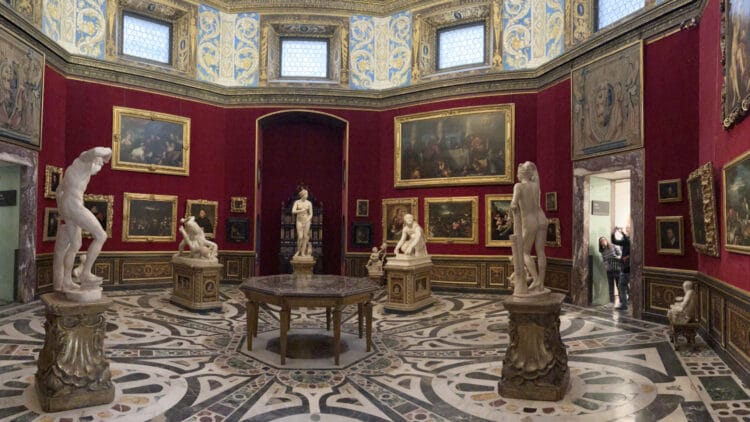
The Uffizi holds one of the finest collections of classical sculptures in Florence. The sculptures are mostly not confined to a single room. Instead, they line the long corridors and appear between major painting rooms, making them easy to see without any detours. Even on a quick, two-hour tour of the best paintings in the Uffizi, visitors pass right by the top sculptures too. The Uffizi sells out most days — buy tickets and book tours early.
Why the Sculptures Matter
The collection of sculptures in the Uffizi reflects the Medici family’s passion for classical antiquity. Many are Roman copies of lost Greek masterpieces.
- These sculptures from antiquity were rediscovered in large numbers during the 16th and 17th centuries. They influenced Renaissance artists, the development of naturalistic art, and provided context for the idealized human forms seen in nearby paintings.
Even a brief look at a few sculptures displayed in the Uffizi helps explain why Renaissance art looks the way it does.
Top 5 Sculptures in the Uffizi
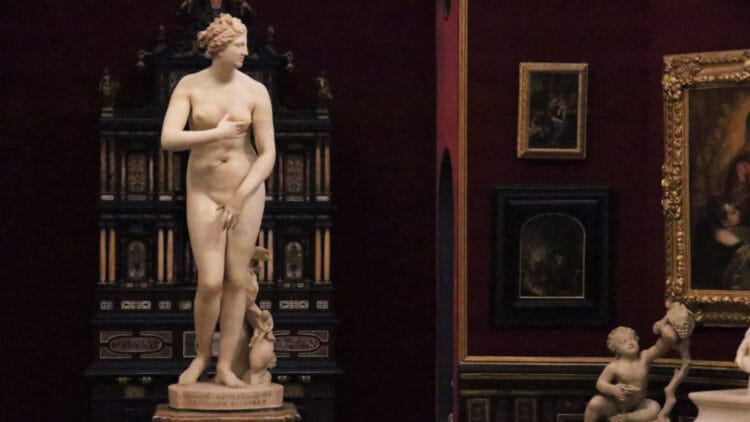
- Venus de’ Medici – Classical Roman sculpture
- Dancing Faun – Hellenistic-style sculpture (Roman copy)
- Niobid Group – Roman copies of Greek originals (multiple figures)
- The Wrestlers — the heads are new, but the bodies are from antiquity
- Laocoön and His Sons – 16th-century copy after a Greek original
Top Sculptures in the Uffizi to Look Out For
The sculptures in ancient Greece and the Roman Empire were rarely unique pieces, with the best and most popular works frequently copied.
Medici Venus (Venus de’ Medici)
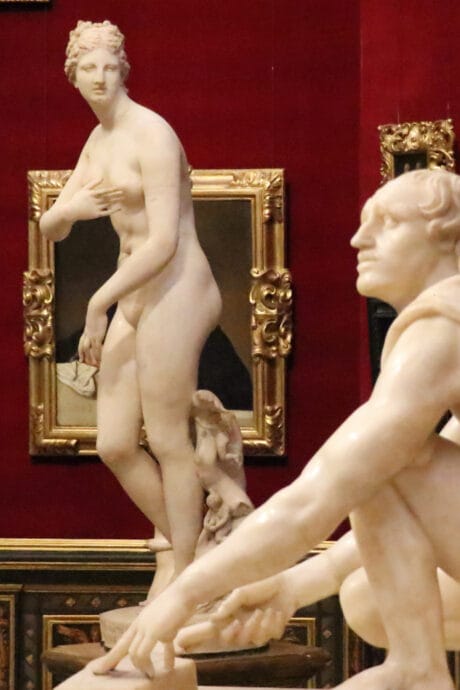
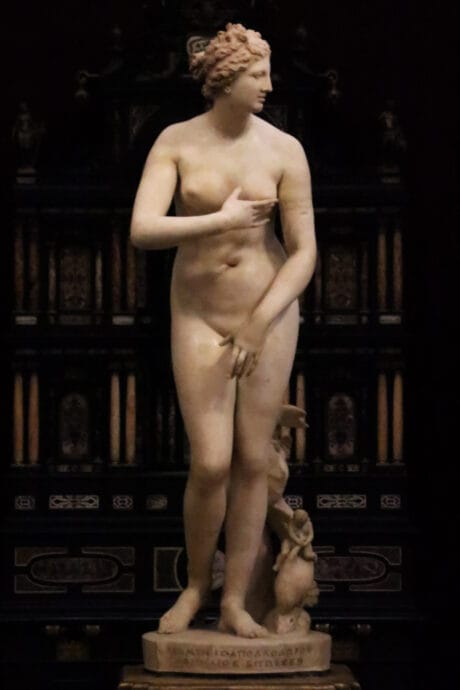
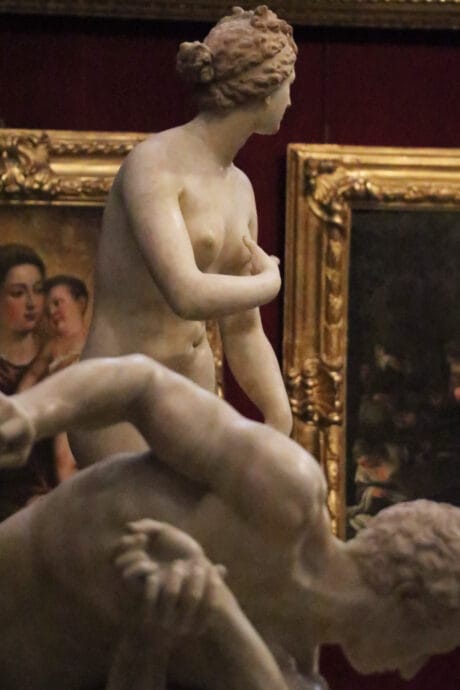
One of the most famous classical statues in Florence, this elegant nude figure of Venus de’ Medici became a model of ideal beauty for centuries. This version dates from the late 2nd century B.C. or early 1st century B.C. In contrast to many Roman copies, this marble is from ancient Greece and is one of the finest surviving versions.
The goddess Venus (Aphrodite in Greek) is caught in the act of instinctively covering her breasts and pubis, as if she were feeling observed by an indiscreet gaze. The original model is that of the famous Aphrodite Cnidia created by Praxiteles in the middle of the 4th century B.C. It was very popular in the Hellenistic and Roman periods and inspired several reinterpretations.
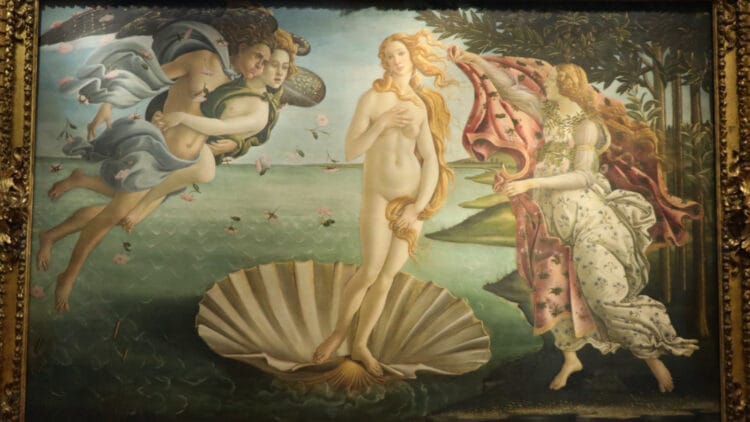
Botticelli clearly got his inspiration from this masterpiece when painting The Birth of Venus, the most famous painting in the Uffizi.
- The Medici Venus is in the Tribune, room A16, on the top floor of the Uffizi. Queues quickly form, as visitors may only look into the room from the door. The Tribune’s two other doors, in rooms A15 and especially the one in A17, often have shorter queues.
Laocoön and His Sons

This large marble copy by Baccio Bandinelli (Florence, 1493-1560) of the Greek original Laocoön and His Sons, now in the Vatican, illustrates a famous scene from the Trojan Wars.

The Trojan priest Laocoön became aware of the deception of the wooden horse. This dramatic composition shows Laocoön and his sons being crushed by sea serpents sent by Poseidon, or by Athena, before they can warn their fellow citizens. Their deaths allow Odysseus and the Greek army to enter the city of Troy while hidden inside the famous horse.
The twisting figures and intense expressions make it one of the most powerful sculptures in the gallery. It inspired many artists, including Michelangelo and Raphael.
Sculptures in the Tribune of the Uffizi
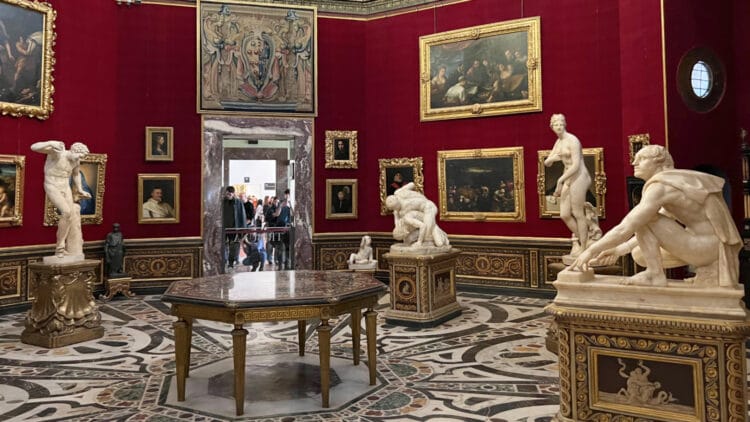
Venus de’ Medici is the top sculpture to admire in the Tribune of the Uffizi. Several further works from antiquity are displayed here and may be seen from one of the three doors of the Tribune.
Dancing Faun / Dancing Satyr
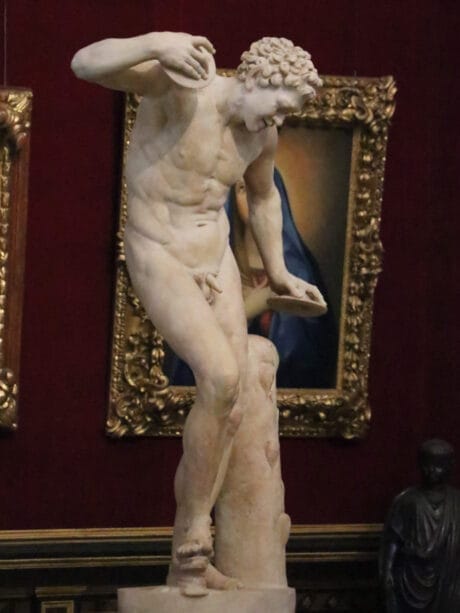
The Dancing Satyr (also known as Kroupezeion) has a body and legs from the 1st century A.D., but the arms and head are 16th-century additions.
The lively and expressive figure captures movement and rhythm, unusual in classical sculpture. The dancing satyr was often complemented with the figure of a seated nymph, as an invitation to dance. The Uffizi displays a Seated Nymph in the second corridor.
The sculpture itself is not unique — at least 31 known versions from antiquity survived in various states of repair.
The Wrestlers
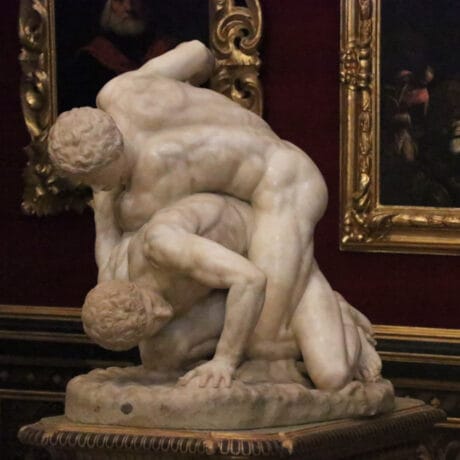
The first-century AD version of a much earlier Greek bronze has been copied frequently since this version was rediscovered in Rome in the 16th century. (Some of the Niobides in Room A39 are from the same villa.)
The complex sculpture was remarkably well preserved, although the heads are new (from the 16th century). The muscular structure and anatomy are realistic. The outcome of the fight is uncertain.
Copies of The Wrestlers may be seen all over the world, but this is the original copy of the Greek original.
Arrotino (The Scythian Slave)
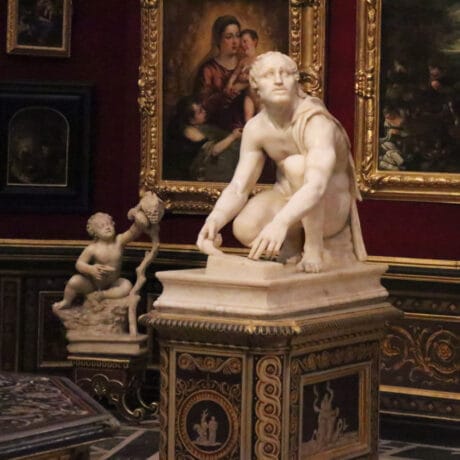
This marble from Asia Minor, dating from the 2nd century AD, goes under several names, including the Knife Grinder, Scythina, or Arrotino.
A tense and focused figure sharpening a blade, full of narrative energy and realism. The debate continues over what exactly is being portrayed. A royal barber plotting? Or, in current thinking, a slave preparing the blade to skin the satyr Marsyas as punishment for challenging the god Apollo. (The Uffizi displays two sculptures of Marsyas strung up, but neither is from the same group.)
Busts and Heads in the Uffizi
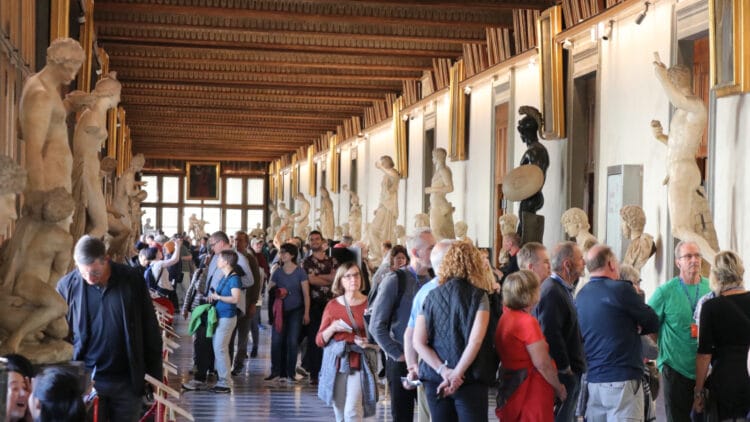
The Uffizi has a large collection of busts, heads, heads on hermas, and portraits from antiquity. Most are marble, but even the odd bronze survived.
The Greek heads often portray deities, philosophers, professions, and many generic unknowns. The Roman, of course, added a lot of imperial family members. Many of the carvings are of astonishingly high artistic quality.
Bust of Antinous
Any Italian museum worthy of the name has an Antinous, and the Uffizi has several. The best version is the Portrait of Antinous as Genius Frugiferus, displayed near the entrance to the Tribune, from the early 2nd century A.D.
This idealized portrait symbolizes youthful perfection and classical beauty. The bust is remarkably well preserved, although Antinous had a nose job in the late 17th century. The bust of his lover, Emperor Hadrian, is nearby.
Niobid Group
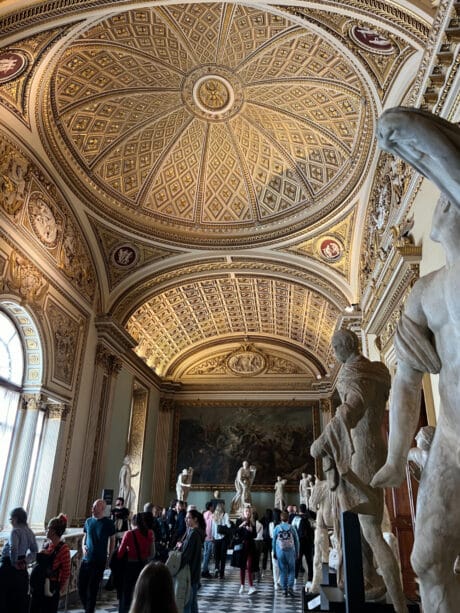
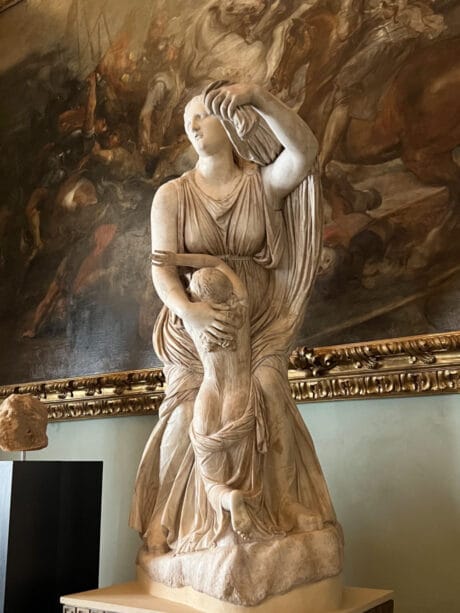
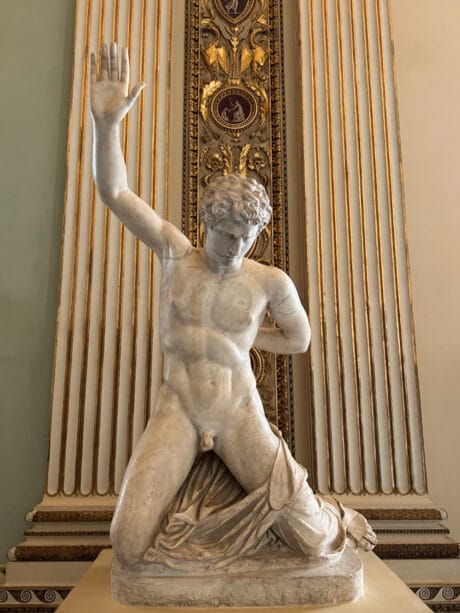
This series of 13 statues from the 2nd century A.D showing Niobe’s children being killed, is best appreciated as a group rather than individually.
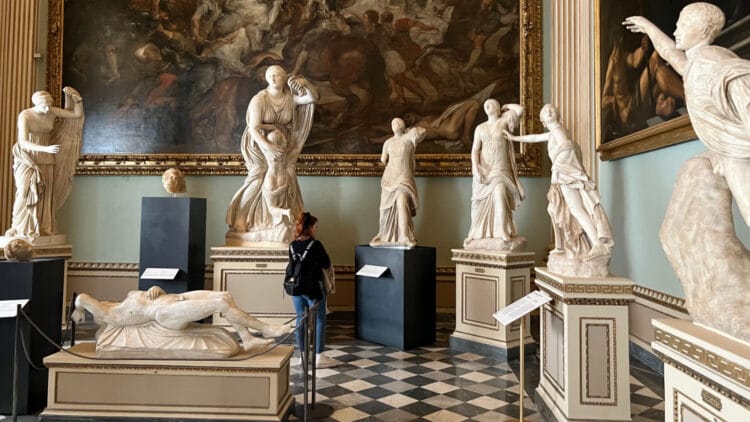
Queen Niobe of Thebes, mother of seven sons and seven daughters, claimed to be a better mother than the goddess Leto (Latona), who bore only the twins Artemis (Diana) and Apollo (by Zeus / Jupiter). Leto ordered her children, both famously good archers, to kill Niobe’s children as punishment for her hubris (excessive pride) and insulting a goddess.
While the children were killed by arrows, Niobe was petrified, but her tears would never stop. As a result, the sculpture group was often used to decorate a fountain, as was the case with these sculptures in Roman times.
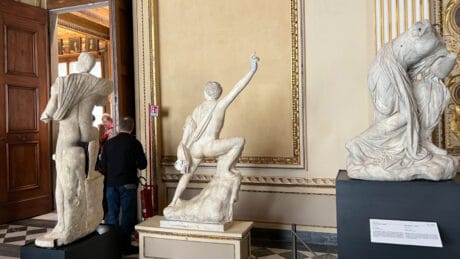
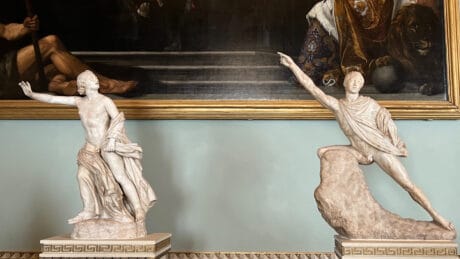
The Niobe Group is displayed in Room A39, a neoclassical hall specifically designed for these sculptures. It is a rare instance in the modern Uffizi where the emphasis is clearly on sculpture rather than paintings. (The two paintings here of Henry IV by Pieter Paul Rubens are the largest canvases in the Uffizi.)
- The killing of the Niobids was a popular theme in art in antiquity. A Greek marble sculpture of Ilioneus, the youngest son, was considered the true gem of the marvelous Glyptothek in Munich for much of the 19th century — it cost 50% more than the leg-spreading Barberini Faun.
Inspirational Torsos
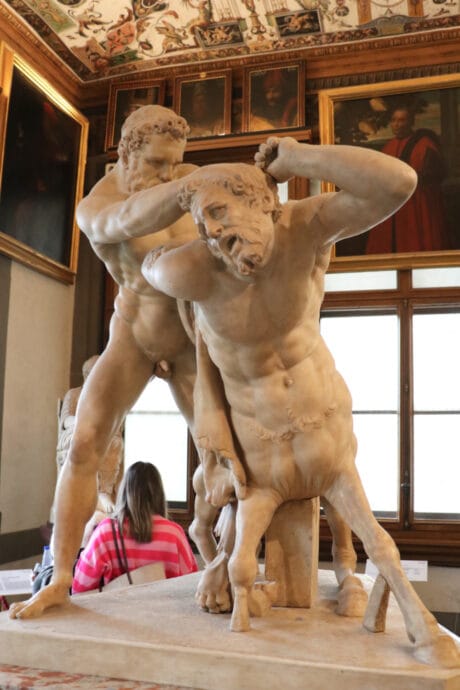
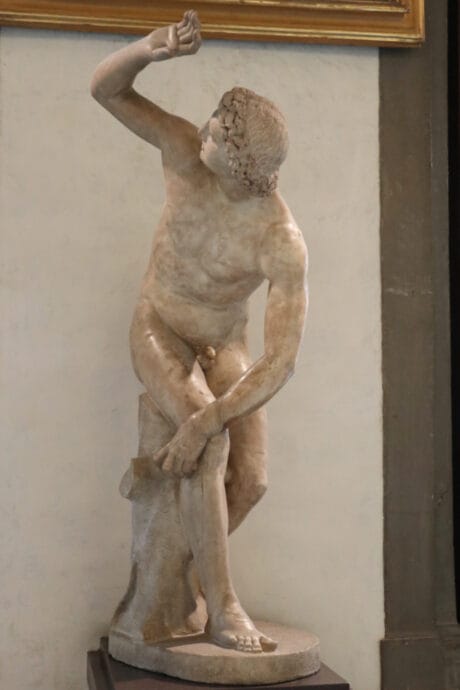
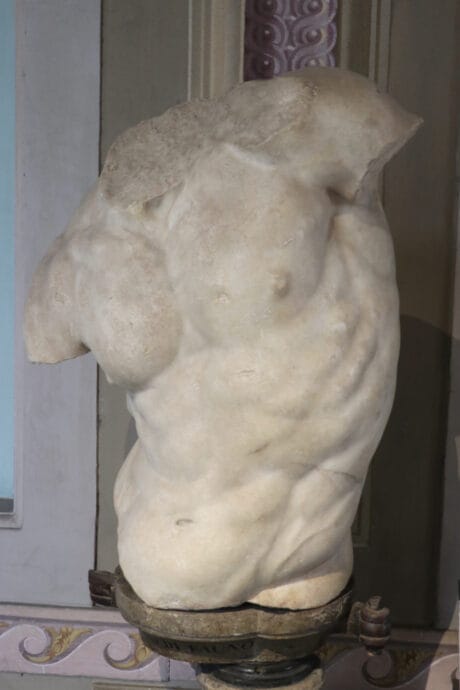
Up to around a century ago, rediscovered sculptures from antiquity was frequently completely restored. Heads and new limbs were commonly added, not always correctly. Hercules Slaying the Centaur Nessus was recreated using the original centaur body and only the hero’s feet. The Discus Thrower‘s arms are wrong — he seems to hide from the sun rather than throwing a disc. A Venus received new arms to cover her modesty, while the original had arms opening her robe to do the exact opposite. Daphnis was turned into Apollo.
Some pieces were never restored and remained an inspiration for many artists. Several are displayed in Room A37 (Cabinet of Ancient Marbles), which is slightly off the main route.
Gaddi Torso
The robust Gaddi Torso is a Greek original from the 1st century BC. It is a young, muscled body, but of a centaur rather than a human. The quality of the work is so high that it was never seriously considered for restoration.
The Doryphoros Torso
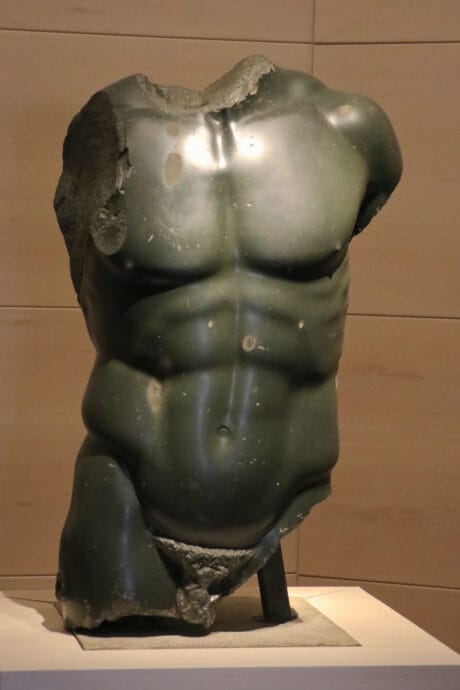
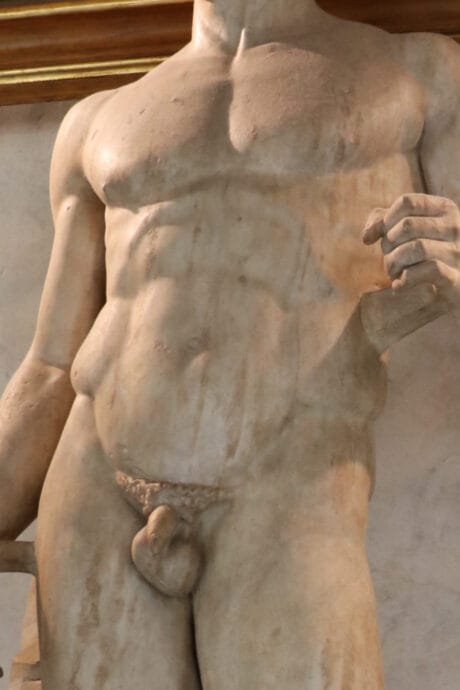
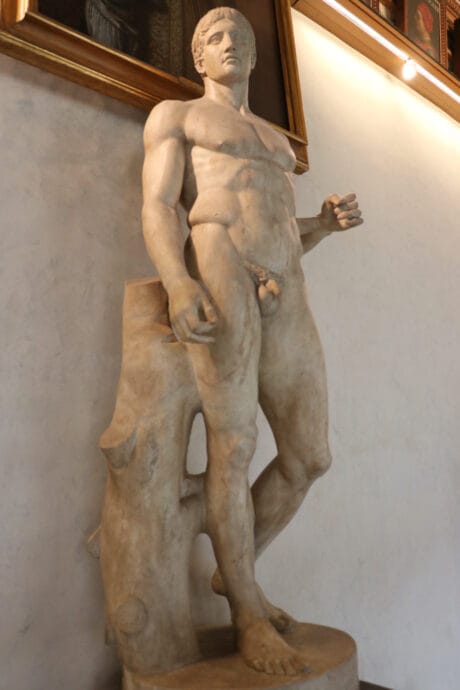
The Doryphoros torso is a fine, early 1st century A.D. copy of the Doryphoros of Polykleitos (5th century BC). This hard-to-work but durable basanite version is one of the most accurate and reliable reproductions of the original Greek bronze.
In Doryphoros (and Diadumenos), Polykleitos solved the problem of the ideal representation of the athletic male figure, standing and revolving.
The Doryphoros of Polycletus (lance bearer) was one of the most often copied sculptures in antiquity, and its influence may be seen in many other later works.
Popular Sculptures
Some additional well-known works that you may encounter in the Uffizi include:
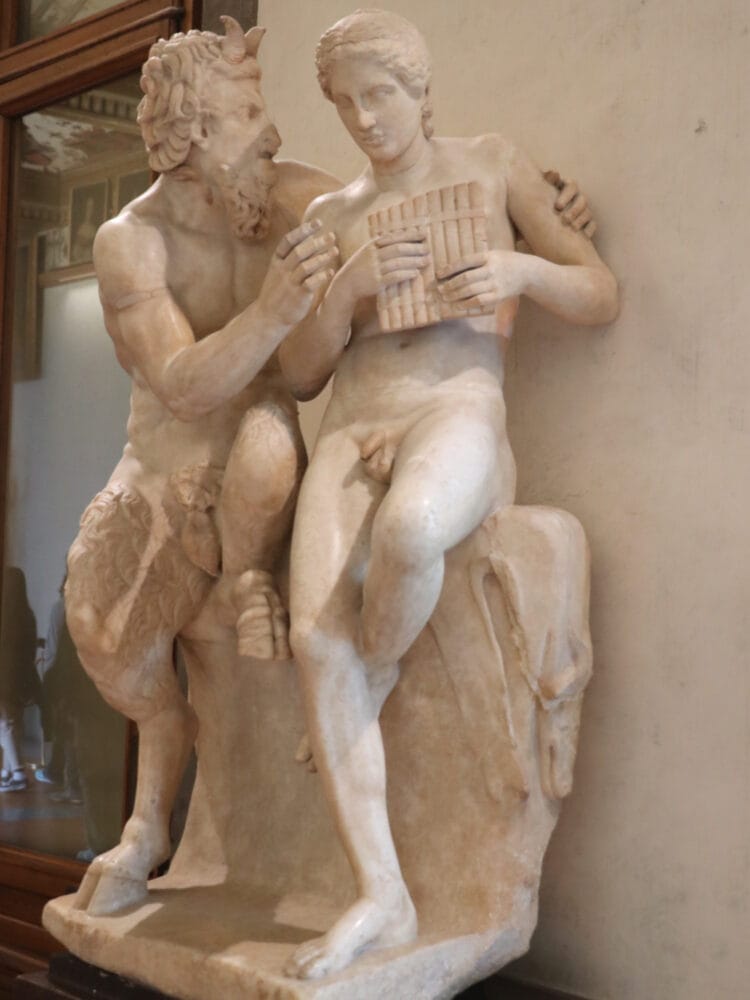
The Romans produced many copies of famous, mostly Greek sculptures, so visitors may recognize several from other museums and galleries. The selection and quality in the Uffizi are generally very good, but not as extensive as, for example, in the National Museum of Archaeology in Naples, the Vatican Museums, or the Capitoline Museum in Rome.
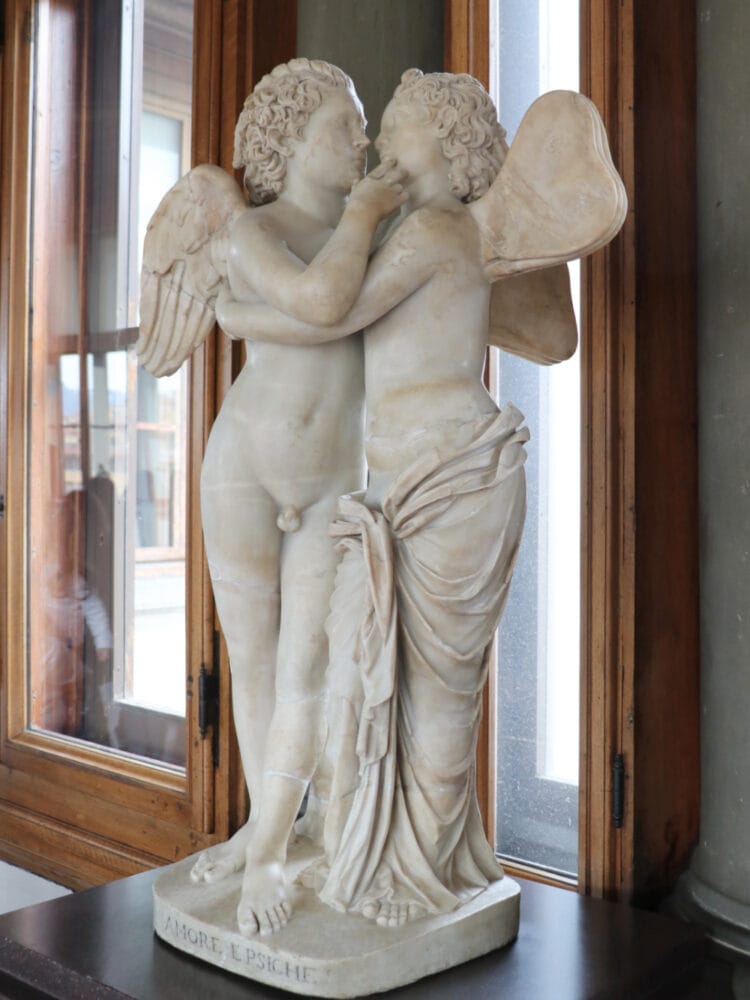
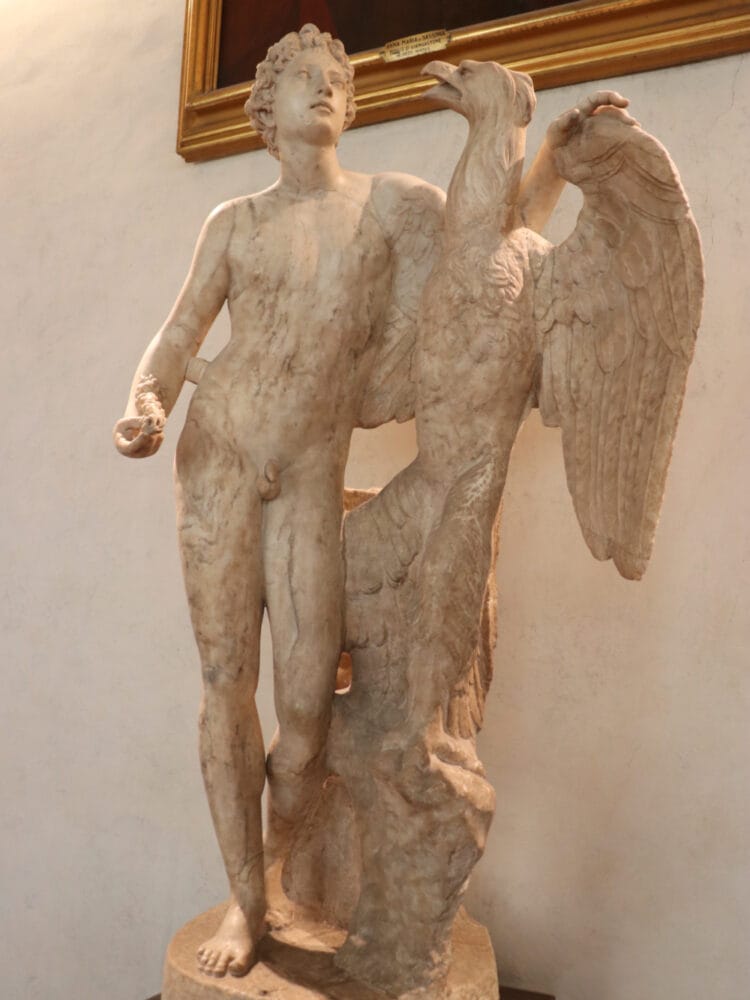
While strolling through the museum, you’ll see the normal variety of Roman emperors, Greek gods, philosophers, and sarcophagi. You’ll see many Apollos, satyrs, athletes, warriors, and the odd animal. Groups include Pan and Daphnis, Ganymede and the Eagle, Hercules Slaying the Centaur Nessus, Bacchus Leaning on a Satyr, Venus and Cupid, Venus and Mars, and Cupid and Psyche.
Never worry about recognizing art, the person, or the event depicted. Most are well described. Even specialists disagree and reinterpret works.
The famous father of archaeology, Johann Joachim Winckelmann, described a young Apollo, who has since been downgraded to Pothos. The Discobolus was first considered to have been the shepherd Endymion.
A few popular works displayed in the Uffizi include:
Farnese Hercules
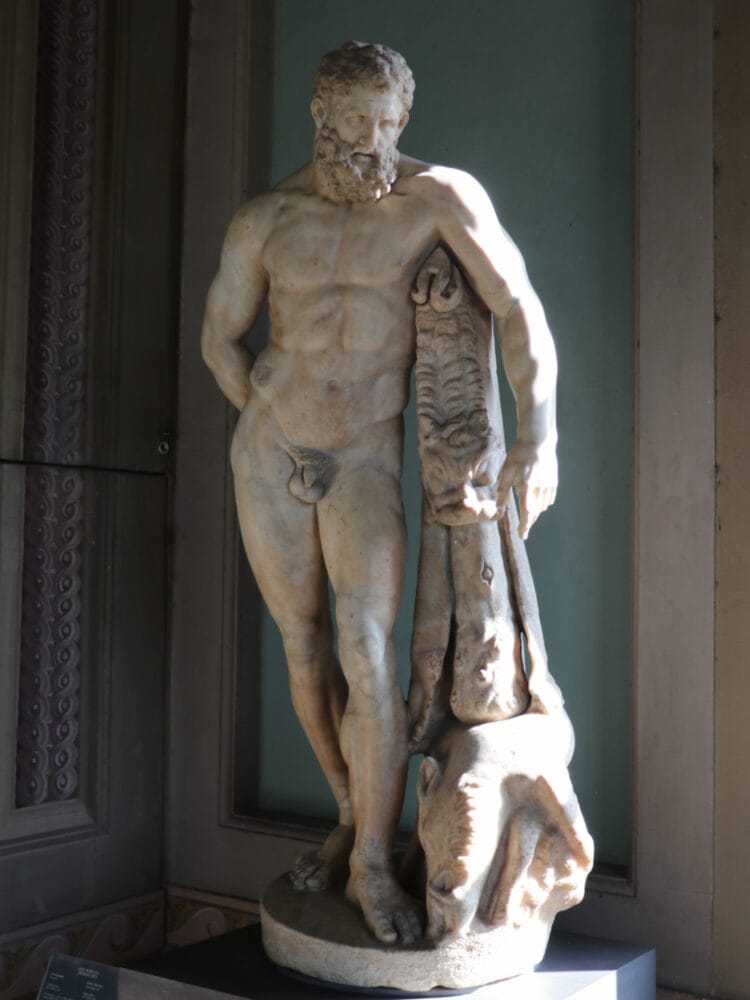
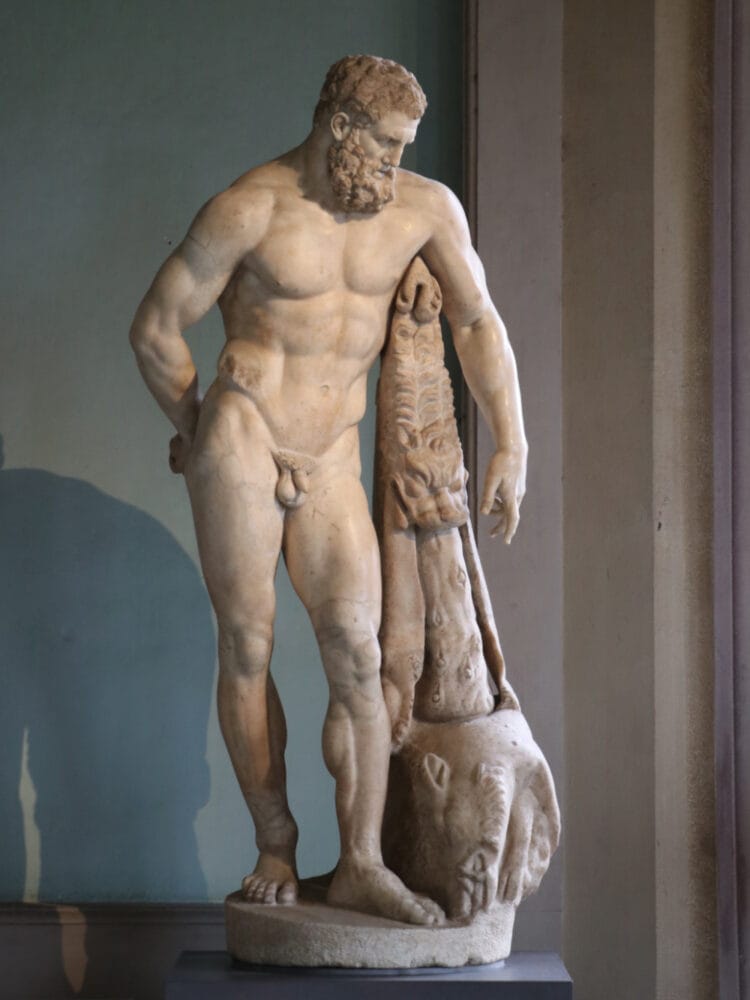
This 2nd-century AD marble shows Hercules resting on his club while holding the apples from the garden of the Hesperides behind his back. The original bronze was probably by Lysippos (4th century BC).
This version of Hercules is frequently copied, even in the modern day, with the most famous probably the monumental one in the National Museum of Archaeology in Naples. There is also a large, if somewhat worn, version in the courtyard of the Palazzo Pitti.
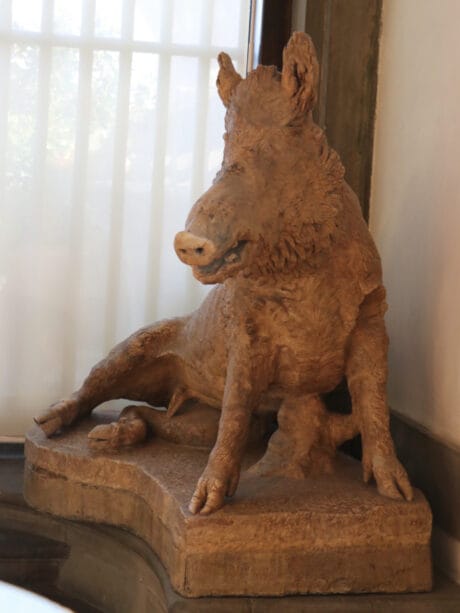
Wild Boar
The Wild Boar (Cinghiale) is a popular sculpture in the Uffizi. A bronze cast by Pietro Tacca (1577-1640) outside the New Market (Loggia del Marcato Nuovo) is even better known and rubbed for good luck. The marble version, rediscovered in the 16th century, is probably a 2nd- or 1st-century BC Roman copy of the Greek original from the Hellenistic era.
She-wolf
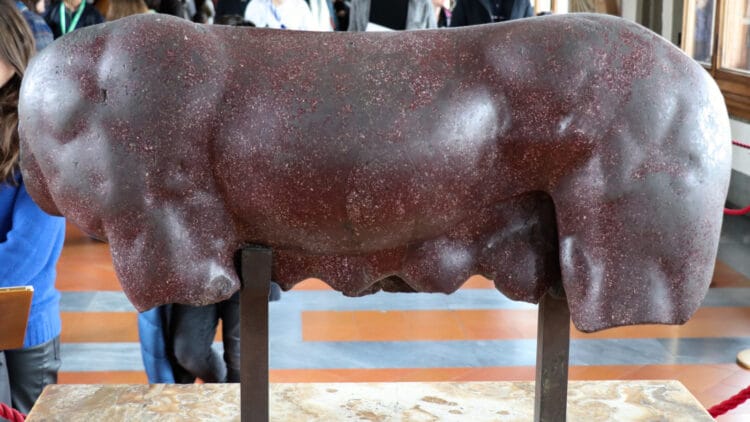
The large fragment of the She-wolf, in Egyptian red porphyry, is from the early 2nd century A.D. This hard stone was difficult to work with and is usually associated with power and wealth. This Capitoline Wolf, who nursed Romulus and Remus, was a symbol of the Roman state.
(A large selection of animal sculptures originally made for various Medici gardens is in the Bargello Museum.)
Hermaphroditus
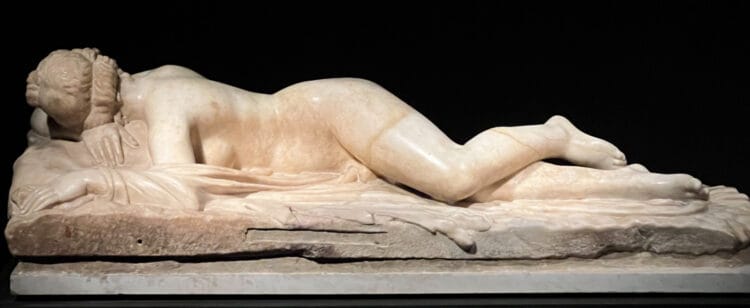
The Hermaphroditus from the 2nd century A.D. in room A40 is of the sleeping Hermaphroditus, son of Hermes and Aphrodite. The nymph Salmaics fell in love with the 15-year-old boy and, being spurned, requested that the gods never separate them. Their bodies were blended, leaving the shape of a woman but with male genitalia. Hermaphroditus was not asked and was not pleased.
The theme was quite popular during the Hadrianic-Antonine age. At least seven similar versions survived — the most famous is in the Louvre, restored and placed on a mattress by Bernini.
Hermaphroditus often appears with Pan. (The Uffizi’s version is not currently on display.)
More Modern Sculptures
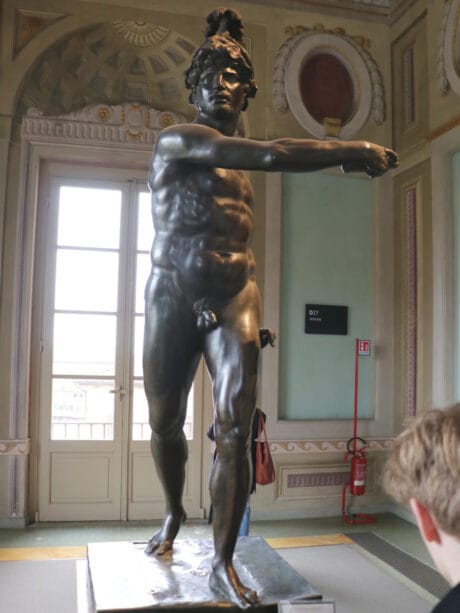
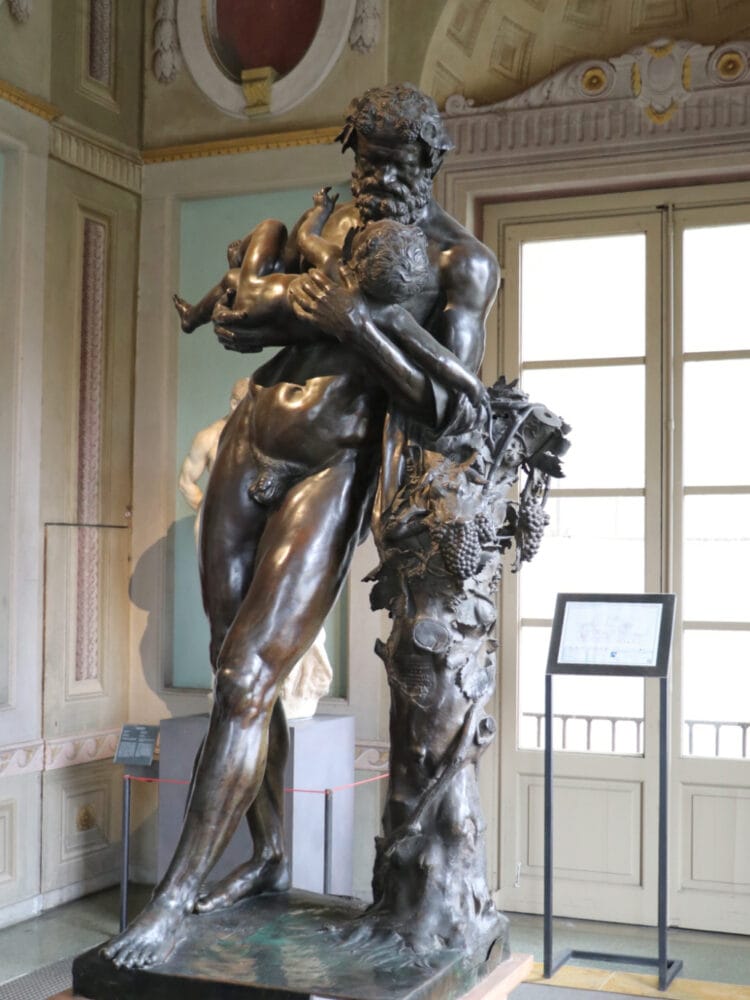
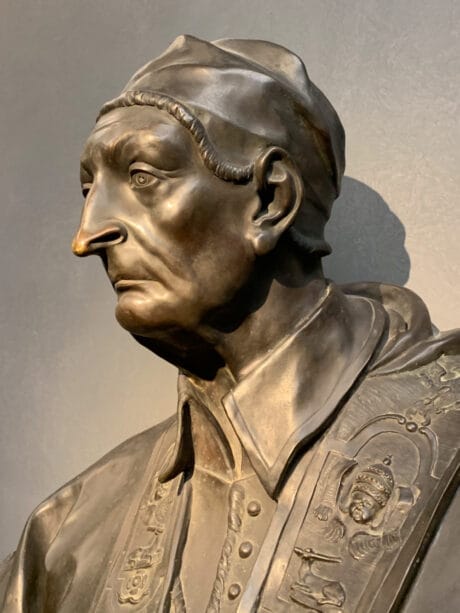
Only a couple of sculptures newer than the Roman Era are displayed. These were mostly contemporary art when acquired by the Medicis in the 17th and 18th centuries. (The best sculptures in Florence from the Renaissance era are in the Bargello, although Michelangelo’s David is of course in the Accademia.)
The huge, bronze Mars Gradivus by Bartolomeo Ammannati (1511-1592) is impossible to miss. It originally belonged to Cardinal Ferdinando de’ Medici, and later Grand Duke. Mars (Aries), the god of war, was the traditional protector of Florence.
This Mars was traditionally displayed facing the bronze Silenus and the Young Bacchus by Jacopo del Duca (1520-1604). It is a copy of the Borghese Silenus now in the Louvre.
A personal favorite is the bronze Bust of Pope Benedict XIII, 1724-30, by Pietro Bracci. This guy must have been the life and soul of every party…
Where to Find the Sculptures
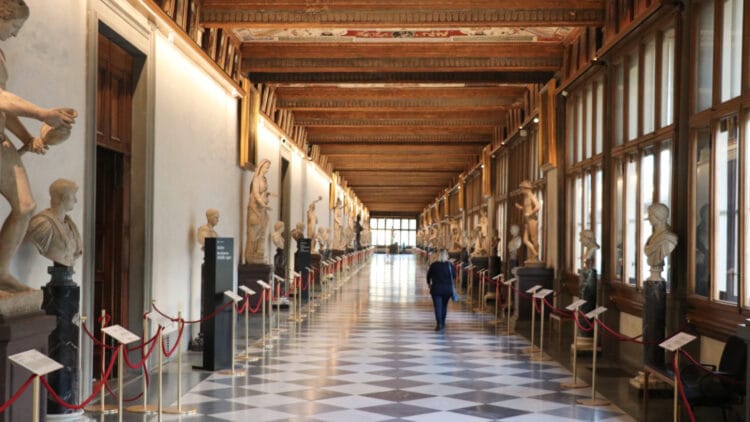
You do not need to search for these works. They appear naturally as you move through the museum. Most are in the corridor on the top floor of the Uffizi, but note the special exceptions:
- Some of the finest sculptures from antiquity, including Venus de’ Medici, are in the Tribune room of the Uffizi. Queues often form at the door in the corridor, but the side doors, especially in room A17, often have fewer waiting.
- The Niobides are in a special neoclassical hall (A39) near the exit on the top floor.
- The Cabinet of Marbles (A37) is slightly off the main route (and often pleasantly quiet).
The sculptures in the Uffizi are not just decorative additions. They are useful for understanding Renaissance art and add depth to any visit without requiring extra time or effort.
Uffizi Visiting Strategy: Book tickets early, use these top visiting tips, follow a 2-hour highlights route, and don’t miss the key sculptures.