The Ancient Agora is after the Acropolis Hill with the Parthenon the most important archaeological site to visit in Athens, Greece. For around 800 years, this square surrounded by monumental buildings was the political, commercial, and cultural center of Athens.

Highlights of a visit to the Ancient Agora of Athens include the beautifully preserved Temple of Hephaistos and a small but interesting museum in the reconstructed Stoa of Attalos. The rest of the archaeological site is mostly only the foundations of former monumental buildings. Some played a very important role in the development and functioning of democracy. Add an audio guide to entry tickets or book a guided tour to understand the importance of this site.
Ancient Agora of Athens

The Ancient Agora of Athens is an archaeological site with a small museum at the former heart of Athens. It was for nearly a millennium the cultural, commercial, academic, and governmental center of Athens. All roads to Athens led here.
For centuries, from the 6th century BCE onwards, this open space was surrounded by monumental buildings including temples, stoas, statues, monuments, and governmental offices. It acquired its final form, before being destroyed, in the 2nd century AD under Roman rule.

The Agora was destroyed and plundered several times through the centuries. First by the Persians in 480 BC, which led to a Greek revival and the construction of the current Parthenon on the Acropolis that still towers over the Agora. The Romans under Sulla pillaged the Agora in 86 BC before rebuilding and expanding several buildings. The Agora never fully recovered from the destruction by the Herulians in AD267. It was largely abandoned after the Slavs attacked in AD 580.

A Byzantine neighborhood developed here from the 10th century onwards. (The Church of the Holy Apostles survived from this period.) The Venetians destroyed the area in 1204 and it suffered some damage in the Greek War of Independence (1826-27).
Archaeological excavations and the clearing of modern housing from the Agora progressed from the mid-19th century onwards.
As with so many ancient archaeological sites, not much has survived to the present. It requires a lot of imagination to understand how the site functioned. A good guide, audio guide (included in many tickets), or guided tour is essential to appreciate the site.
Visit the Ancient Agora of Athens Archaeological Site

After passing the ticket gate at the Ancient Agora, use the information board for a good survey of the site. Of all the classical buildings on the map of the Agora (from AD 150) only the Temple of Hephaistos survived in recognizable form.
The large Stoa of Attalos is a 1950s reconstruction to house the museum. It is also easy to identify the Panathenaic Way. This diagonal road through the square was the processionway to the Acropolis and Parthenon.
The entrance to the museum building is at the far end along the Panatheanic Way. I would visit the museum first but it doesn’t make much of a difference if the site is explored first.
Visit the Museum of the Ancient Agora of Athens

The Museum of the Ancient Agora of Athens is in the two-story, double-colonade Stoa of Attalos. The American School of Classical Studies built it in the 1950s to house the archaeological discoveries of the Agora site.
The new building closely followed the designs of the original 2nd century BC stoa built by Attalos II, King of Pergamon. It was a commercial center with 21 shops on each floor and space for meetings and simply hanging out.
The open gallery area has 45 Doric columns on the outside and 22 Ionic columns in the center. Several larger sculptures and decorations are displayed here (and on the second floor) but as is usually the case, the best works are in the National Museum of Archaeology. The open gallery is particularly photogenic in the late afternoon.
Exhibitions of the Ancient Agora Museum

The main permanent exhibition of the Ancient Agora is on the ground floor of the stoa. This long rectangular hall uses the space of ten shops. The display cases are mostly chronological and thematic.
The oldest items are vases, figurines, and weapons found in graves and wells from the Neolithic, Bronze Age, and Mycenaean periods. More numerous and important are the items from the Classical and Late Classical periods. Note particularly the exhibits related to Athenian democracy and civic governance.
Some interesting displays include:


1st cent. B.C
In the manner of the archaic kouroi
A smaller space on the second floor (not always open) has temporary exhibitions, sculptures, and interesting models of the Agora. The second floor also gives good views of the archaeological site.
The only toilets of the archaeological site are on the ground floor near the stairs.
Visit the Archaeological Site of the Ancient Agora in Athens

Slightly uphill from the museum is the Church of the Holy Apostles. This typical Greek-cross church was erected around AD1000. The cupola interior has a Christ Pantocrator. On the way note the wall built after the Herulian raid (267 AD). It reused any rubble available to hastily erect some kind of protective fence.
Most of the rest of the Agora archaeological site requires a lot of imagination to comprehend the original structures. But for the classical temple, only foundations and rubble remain.
The way to the Temple of Hephaistos leads along the foundation of the Middle Stoa. This single-story shopping center was longer than the rebuilt Stoa of Attalos.

Around halfway along the stoa is a large Corinthian capital. It was carved in the 4th century BC and is a very early example of this exuberant order that was always more popular with the Romans than with the Greeks. This capital was incorporated into the Odeon of Agrippa, originally constructed in 15 BC. The roof collapsed around AD 150 and the rebuilt Odeon with 500 seats was only half the original size. The Herulians destroyed this Odeon in AD 267. The surviving walls and pillars were incorporated into a large palace complex.
Home of Athenian Democracy

The circular shape of the foundations and platform of the Tholos marks the seat of the executive government of classical Athens. The male population of Athens elected a council of 500. This council elected 50 as ministers. These ministers met at the Tholos. Many lived here, as at least a third was required to be present at all times.
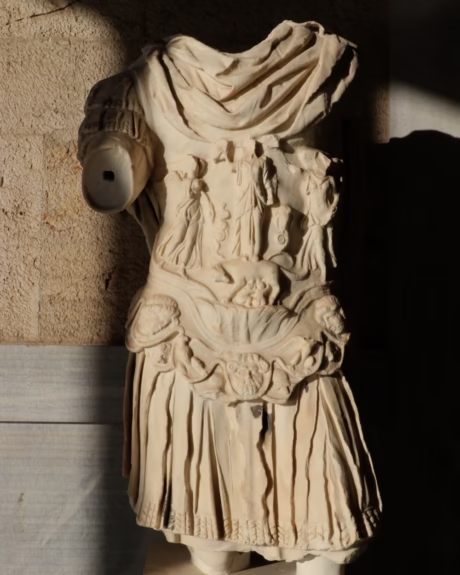
Nearby is a copy of the headless statue of the Grecophile Emperor Hadrian (ca. AD120). (The original is at the museum.) The breastplate shows the link between Athens and Rome. Athena is depicted standing on a she-wolf suckling Remus and Romulus. Other sites in Athens associated with the Grecophile Hadrian include the nearby Library of Hadrian and, on the other side of the Acropolis Hill, Hadrian’s Arch and the ruins of the massive Temple of the Olympian Zeus.
Temple of Hephaistos in Athens

The Temple of Hephaistos is the best-preserved building from antiquity in the Ancient Agora archaeological site. It is also one of the best-preserved Greek temples anywhere in the world. It survived largely due to its use as an Orthodox church from around AD 700 to 1833. The temple was then used as a museum until the 1930s.
The original Temple of Hephaistos was destroyed in 480 BC during the Persian invasion of Greece. It was only restored decades later with the decorations only finished in 415 BC.

Hephaestus — Greek Olympian God
The temple is dedicated to Hephaestus (Vulcan in Roman), the god of artisans, blacksmiths, carpenters, craftsmen, fire, metallurgy, metalworking, sculpture, and volcanoes. According to some versions, he was so ugly that his mother, Hera (wife of Zeus), threw him off Mount Olympus. He is often portrayed with a limp leg or big foot in art.
To balance his ugliness and deformities, he was married to Aphrodite, the most beautiful female in the universe. Her (in)famous philandering is a recurrent theme in art. A famous episode was being caught in flagrante with Ares (Mars) and exposed to the other gods. Despite this episode, Hephaestus still had to produce the weaponry for Ares, the god of war.
The Temple of Hephaistos is around half the size of the Parthenon, which can clearly be seen from the Agora. This peripteral temple has six fluted Doric columns on the short sides and 13 on the longer. (Double counting the corner pillars.)

Like the Parthenon, it had reliefs and sculptures on the pediments and friezes. These illustrated a variety of battles between the Athenians and other nations and mythical figures. Most of the metopes are well-worn by the ages. The fights between the Lapiths and Centaurs are probably the easiest to identify. (A fine example of the Centauromachy from the Parthenon, South Metope 1, is in the Acropolis Museum, while the finest collection is part of the controversial Elgin Marbles in the British Museum in London.)
Ancient Agora in Athens Visitors Information

Opening Hours of the Agora Museum and Archaeological Site
The Agory Archaeological Site and the Museum of the Ancient Agora in the reconstructed Stoa of Attalos are open daily.
Opening hours are daily:
- 8:00 to 17:00 — November to March
- 8:00 to 18:00 — October
- 8:00 to 20:00 — April to September
Tickets for the Ancient Agora Archaeological Site and Museum
Tickets for the Ancient Agora always include admission to both the archaeological site and the museum in the rebuilt stoa. Time-slot reservations are required but these are usually not a problem for onsite purchases during the low season.
Tickets for the Ancient Agora in Athens are €10 (€5 in the winter months). The 5-day combined ticket (€30) which includes time-slot reservations is a good option. An interesting tour explains Greek mythology with visits to the Agora and Acropolis.
The cheapest online tickets are from Hellenic Heritage. Many resellers add useful audio guides to tickets. Audio guides are very useful for making sense of the archaeological site. At Hellenic Heritage, pick Ancient Agora in the Attica & Central Greece region. (The Roman Agora or Roman Forum is a different site.)
The 5-Day Combined Ticket (sometimes advertised as Acropolis +6 Sites or similar) includes admission to the Acropolis & Slopes, the Ancient Agora, Hadrian’s Library, Kerameikos, Aristotle’s School (Lyceum), Olympieion (Temple of Zeus), and the Roman Agora. It is a skip-the-line ticket at the Ancient Agora and all sites other than the Acropolis Hill.
These combination tickets require only a time-slot reservation for the Acropolis. See any of the other sites within a five-day period before or after visiting the Acropolis without requiring further time-slot reservations. This is quite a good time-saver option, as it is easy to simply drop in at any of the smaller sites when passing by.
The information on the official Agora museum website of the Culture Ministry is more impressive than the website design.
Transportation to Visit the Ancient Agora in Athens

The Ancient Agora of Athens archaeological site is to the north of the Acropolis Hill. The entrance is via a bridge across the railway line that cuts through parts of the site.
The easiest transportation is by metro with Monastiraki the closest metro station. (The train passing directly next to the Stoa of Attoles museum is a regional train and of little interest to tourists.) From most other tourist sites in Athens, walking is the simplest option.
More on Visiting Athens

- Acropolis & Parthenon:
- Acropolis Museum
- National Archaeological Museum of Athens:
- Ancient Agora — Archaeological Site and Museum
- 5-Day Combination Tickets — Worth it?
- Visit the Museum of Cycladic Art
- Cheap Public Transportation to Athens Airport — Bus X95 is cheapest, Metro M3 is fastest.
- Odysseus — the official website of the Ministry of Culture and Sports has better information than the very old-fashioned design.