Follow this simple route to see the top highlights of the Uffizi Gallery in Florence in about two hours. It focuses on the most famous Renaissance paintings while keeping walking to a minimum.
The Uffizi Gallery is vast, but most visitors can see the key masterpieces in about two hours. This route focuses on the most famous paintings while keeping walking to a minimum. The Uffizi is in a U-shaped building with the most important works on the top floor (2nd). The first floor also has quality art, but similar works are also found in other top museums. If time is limited, spend most of it on the top floor — these are the artworks that make the Uffizi really special.
Guided tours will usually cover these highlights. Book tours or buy Uffizi tickets early — the museum sells out many days of the year.
→ Start on the top floor (second level) and head straight to the Botticelli rooms (A9–12).
Quick Navigation: Jump directly to:
Botticelli · Leonardo · Michelangelo & Raphael · Titian · Caravaggio
Earlier Masters (Quick Context Stop)
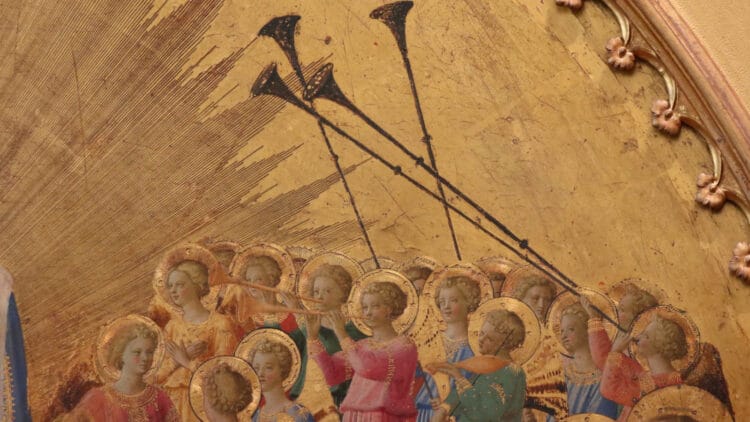
Even a quick look at these late Gothic works helps put the Renaissance in context.
- If entering the Uffizi first thing in the morning, go to the Botticelli Rooms (A9-12) and the Tribune (A16) first, then backtrack here to the late Middle Ages (A4-7).
Top 10 Must-See Artworks in the Uffizi Gallery
If you are short on time, these ten masterpieces are the absolute art highlights of the Uffizi Gallery in Florence:
- The Birth of Venus – Sandro Botticelli
- Primavera – Sandro Botticelli
- Annunciation – Leonardo da Vinci
- Adoration of the Magi – Leonardo da Vinci
- Doni Tondo – Michelangelo
- Madonna of the Goldfinch – Raphael
- Venus of Urbino – Titian
- Madonna with the Long Neck – Parmigianino
- Medusa – Caravaggio
- Venus de’ Medici – Classical Greek sculpture
Start with Botticelli’s rooms, continue through Leonardo and Michelangelo, and look out for the classical sculptures displayed along the corridors before finishing with Caravaggio.
Late Medieval and Gothic Paintings
Three Madonnas in the first rooms were painted within two decades of each other, but seem a world apart:
- Rucellai Madonna (Virgin and Child enthroned, surrounded by angels) – Duccio, 1285. Sienese elegance, refined and decorative, but two-dimensional.
- Santa Trinita Maestà (Virgin and Child Enthroned, and Prophets) – Cimabue, 1290-1300. More Byzantine, but at least some attempts at creating depth.
- Ognissanti Madonna (Virgin and Child enthroned, surrounded by angels and saints) – Giotto, c. 1300-5. A turning point toward naturalism in Western painting, a century before the Renaissance. (For more Giotto frescoes, visit the nearby Santa Croce and the Scrovegni Chapel in Padua.)
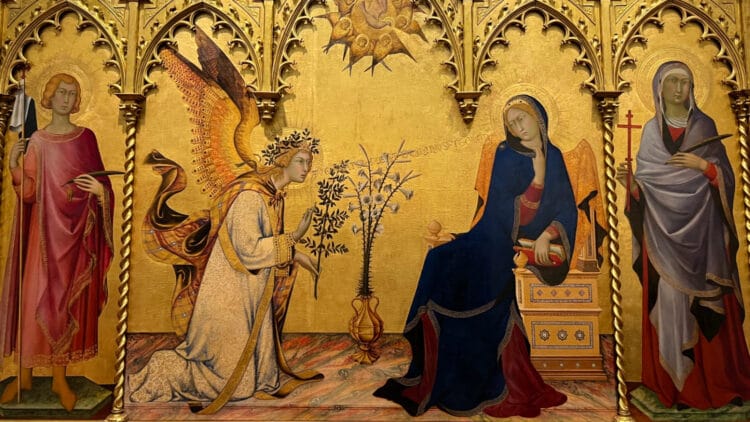
Annunciation with St. Maxima and St. Ansanus — Simone Martini, 1333. All glittering gold, but never had a Mary looked less happy to be pregnant.
Even in the Renaissance and later, biblical events remained the leading themes in Florentine art. The Madonna (Virgin, Mary, Mother of Christ) is frequently depicted — often with child (Jesus Christ) and other persons (many who historically could never have met her). The Annunciation, where the archangel announced her pregnancy, is also a popular theme — compare the early works here with Leonardo’s.
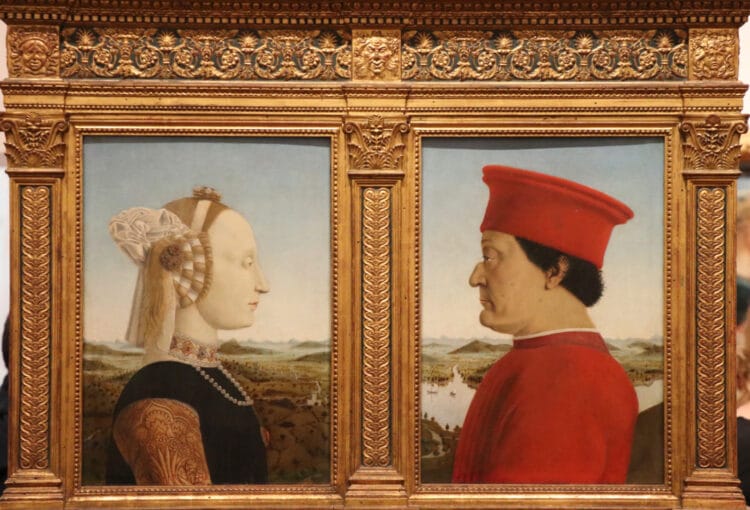
Before hitting the Renaissance, a quick look at two paintings to compare with later versions:
- Duke and Duchess of Urbino – Piero della Francesca, 1473-5. Iconic profile portraits with a serene landscape backdrop. Compare with the Titian profiles.
- Battle of San Romano – Paolo Uccello, 1435-40. The Florentine victory over Sienna and Milan is an early use of perspective with an almost surreal composition.
Botticelli Paintings in the Uffizi
The Botticelli Rooms (A9-12) are always crowded — go early or late in the day.
The museum has several paintings by Sandro Botticelli, but the two standout works are:
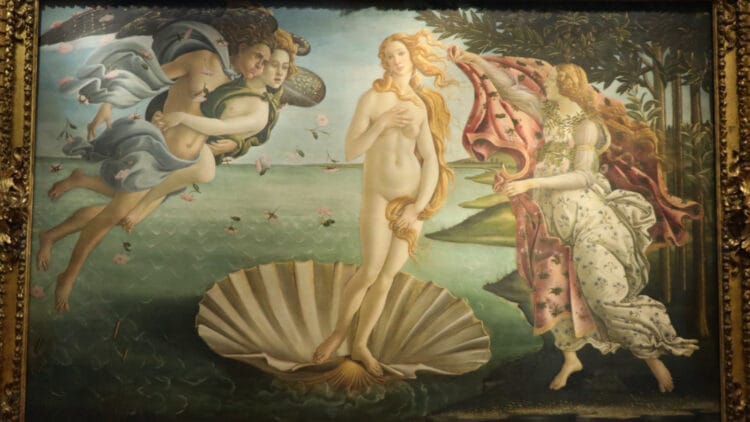
The Birth of Venus
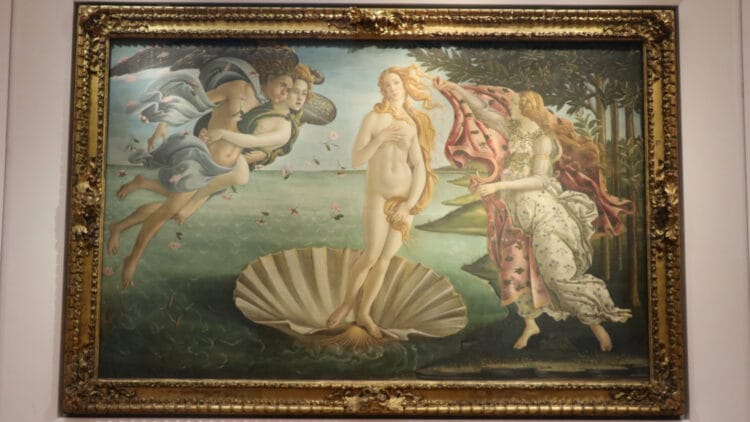
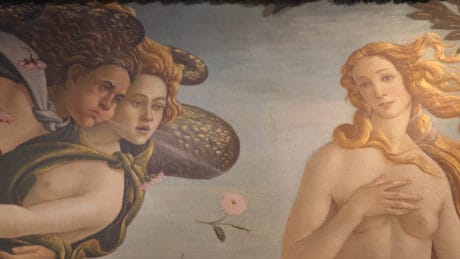
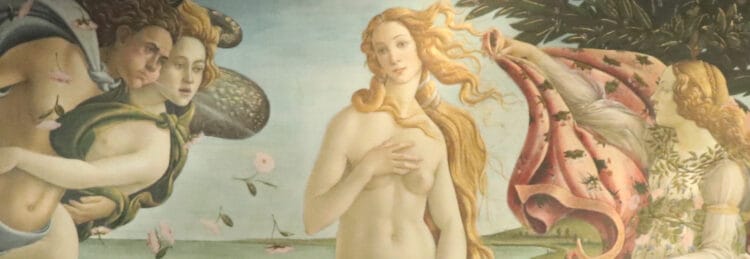
The Birth of Venus, 1485 – The single most famous painting in Florence: Venus emerging from the sea on a seashell. Iconic, poetic, and always crowded. A highlight of European art.
Primavera (Allegory of Spring)
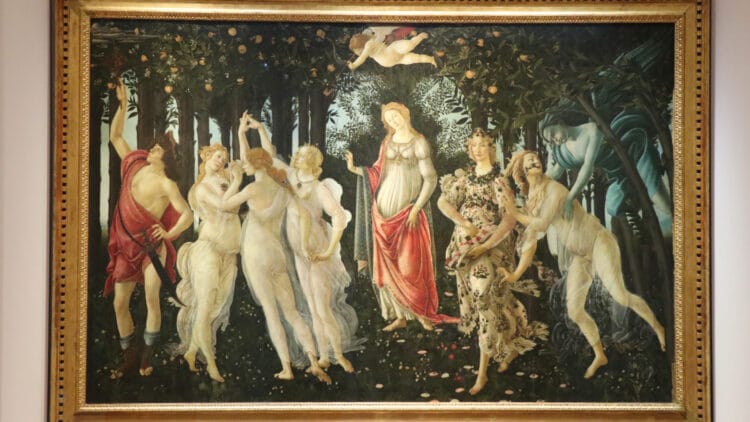
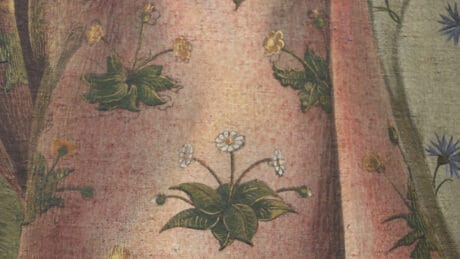
Primavera (Allegory of Spring), 1480 – A complex allegory of spring filled with mythological figures, rich in symbolism and detail. A world away from medieval Christian art.
More Botticelli Paintings in the Uffizi
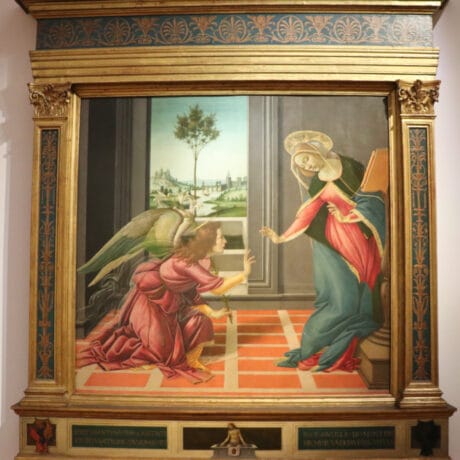
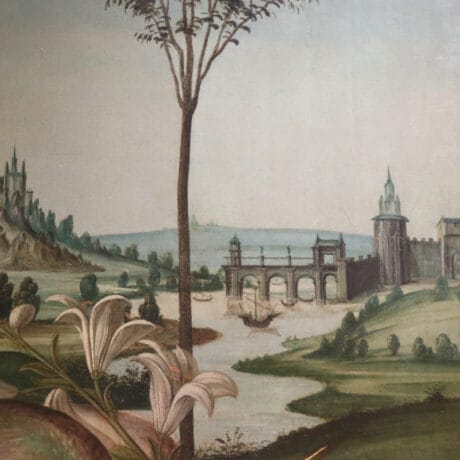
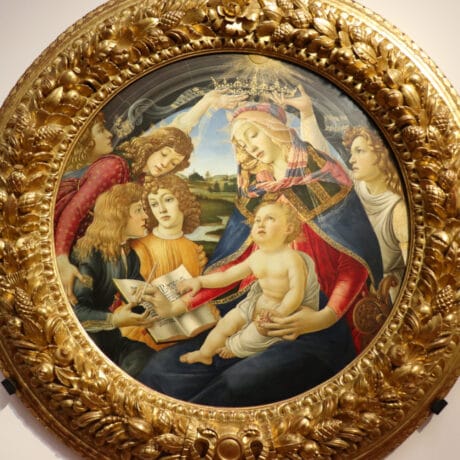
Compare Botticelli’s Annunciation, 1489, with Martini’s and Leonardo’s. His round Virgin and Child, and Angels (Madonna of the Magnificat), 1483, and further paintings have Mary more resembling Venus than the more normal woman Michelangelo painted.
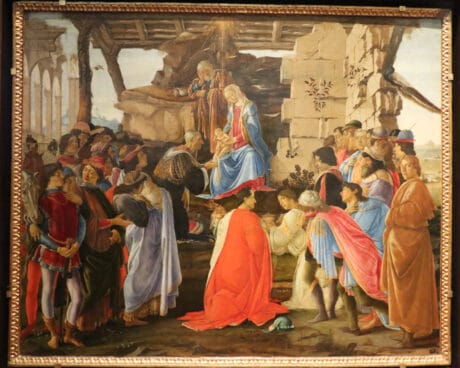
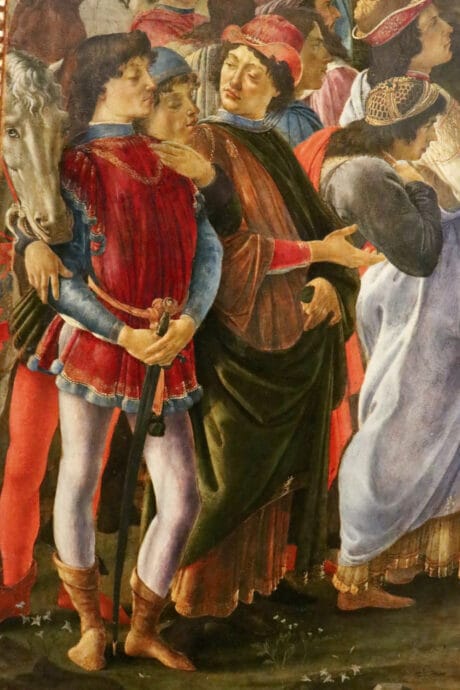
In the Adoration of the Magi, 1470-75, Botticelli painted himself on the far right. The painting also has around a dozen Medicis from three generations. Art historians generally agree that the old man at Jesus’ feet is Cosimo the Elder. The Uffizi claims Lorenzo the Magnificent is in the group on the right (dressed in red and black), while his brother Giuliano is on the far left with a sword (and the I’m-a-Medici-and-I-know-it stance). (Many guides and specialists have the brothers the other way round, or even elsewhere in the crowd.)
Choose Uffizi time slots wisely…
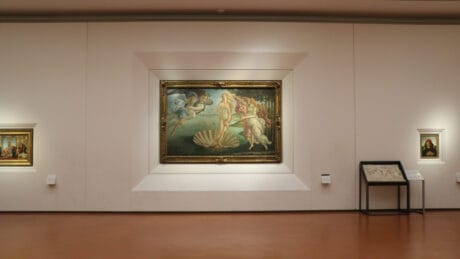
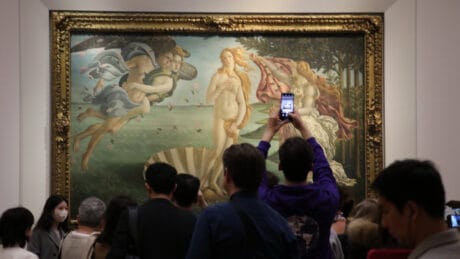
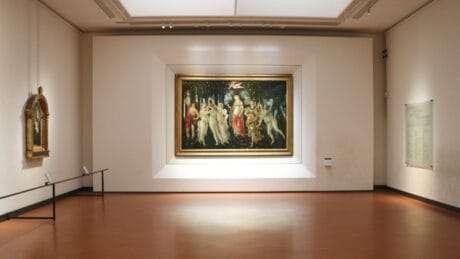
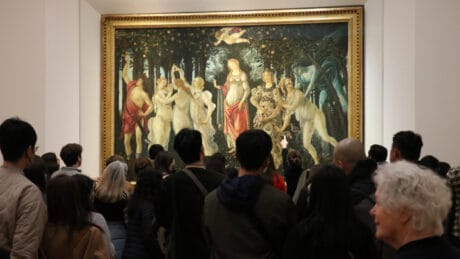
These are the most famous paintings in the Uffizi and are often crowded. If entering the museum early morning, head here immediately. (Both paintings are currently in A9 but should return to A11 and A12 towards the end of 2026.)
Venus de’ Medici in the Tribune
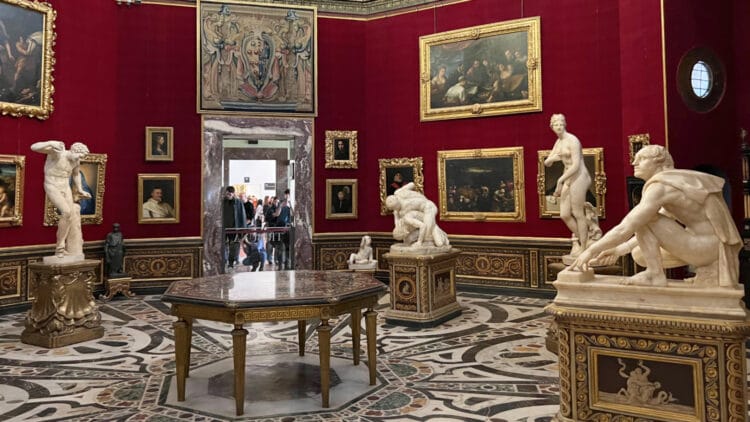
The Medici’s favorite sculptures from antiquity are in the Tribune (A16). These include:
- Venus de Medici — a Greek marble that clearly inspired Botticelli and many others.
- The Wrestlers — original but for the heads.
- The Dancing Satyr — an invitation to dance
- The Knife Grinder — Hellenic-style but a Roman copy.
The Tribune room may only be admired from outside one of the three doors. The door in the corridor is usually the busiest; Room A17 often has the shortest queue.
→ See also Top Sculptures in the Uffizi Gallery – What to See and Where for a longer description.
Top 10 Sculptures to See in the Uffizi Gallery
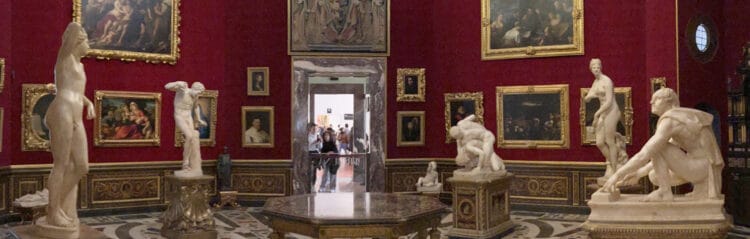
In addition to its famous paintings, the Uffizi Gallery has an excellent collection of classical sculptures. These are the most important works to look out for.
- Venus de’ Medici – Classical Roman sculpture
- Dancing Faun – Hellenistic-style sculpture (Roman copy)
- Arrotino (The Scythian Slave) – Hellenistic-style Roman sculpture
- Bust of Antinous – Roman imperial portrait
- Niobid Group – Roman copies of Greek originals (multiple figures)
- Torso of a Centaur – Roman sculpture fragment
- The Wrestlers — the heads are new, but the bodies are from antiquity
- Laocoön and His Sons – 16th-century copy after a Greek original
- Wild Boar — one of the most popular sculptures in Florence.
- Doryphoros torso in basanite — the athletic male figure, standing and revolving.
Most of these sculptures are displayed along the long corridors, making them easy to enjoy while moving between the main painting rooms.
→ See also Top Sculptures in the Uffizi Gallery – What to See and Where for a longer description.
Renaissance Beyond the Alps
Although the Uffizi has many fine paintings by other European artists, you probably didn’t travel to Florence to see German, Flemish, and Dutch paintings. However, before taking the U-turn to the second wing, pop into room A20 to see:


In Adoration of the Magi, 1504, Albrecht Dürer (from Nuremberg in Germany) elegantly combined Nordic models and Italian influences. It is a masterpiece in its own right, but the direct influence of Leonardo will be revealed soon. (Dürer’s woodcuts and prints widely circulated in Italy and influenced several Italian artists in return.)
Leonardo da Vinci in the Uffizi
The two paintings by Leonardo da Vinci are the main attraction in Room A35:
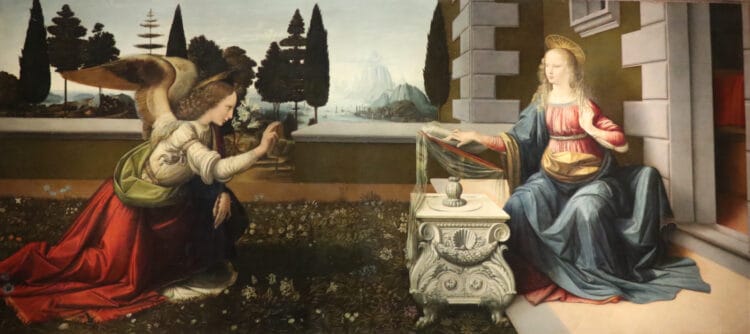
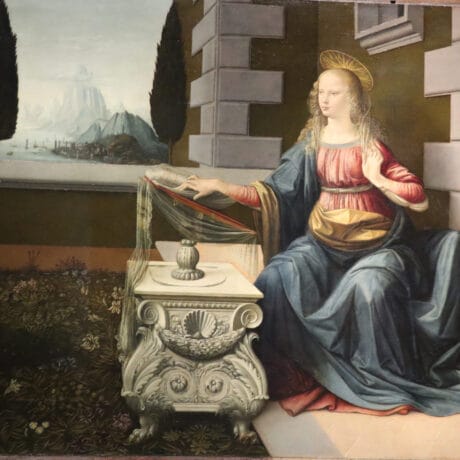
Annunciation (c. 1472) – an early Leonardo masterpiece already showing his mastery of perspective and atmosphere. (When viewed from the side, the Virgin’s right arm is no longer too long.)
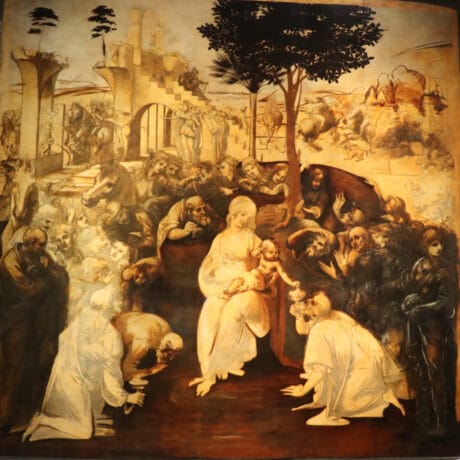
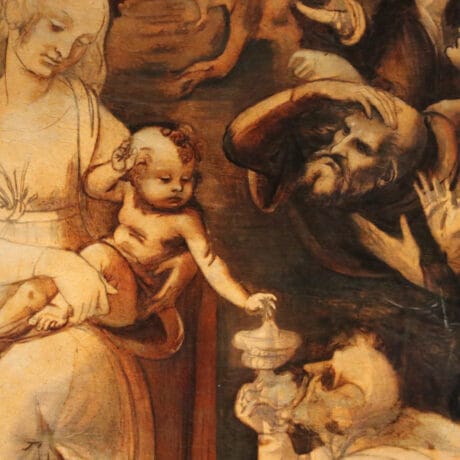
Adoration of the Magi (c. 1482) – offers a fascinating insight into Leonardo’s working process. This dynamic, unfinished work reveals Leonardo’s process, combining drawing, ink, and oil in a highly dynamic composition.
It is full of energy, although Leonardo never got around to finishing it. However, it clearly inspired Dürer’s painting seen earlier (A20).
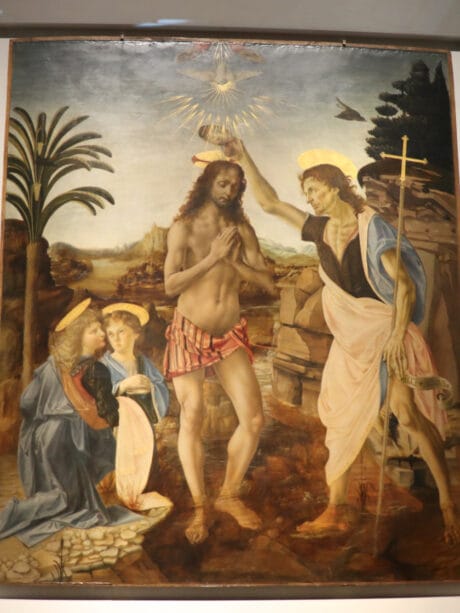
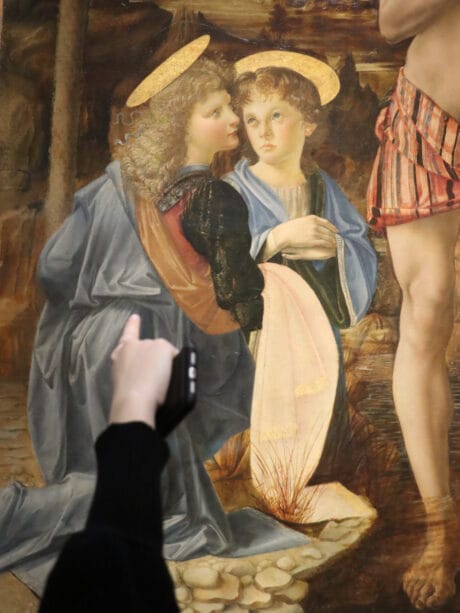
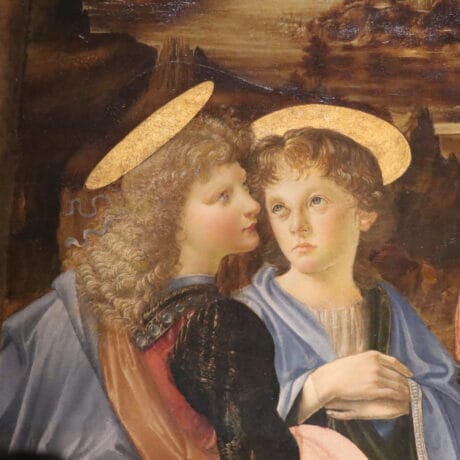
The Baptism of Christ (c. 1470-5) is by Leonardo’s teacher, Andrea del Verrocchio, but the young Da Vinci painted the better angel. Current thinking credits Leonardo also with the riparian landscape, golden light, and the figure of Christ.
Michelangelo and Raphael
This room contains some of the most important High Renaissance paintings in the Uffizi.
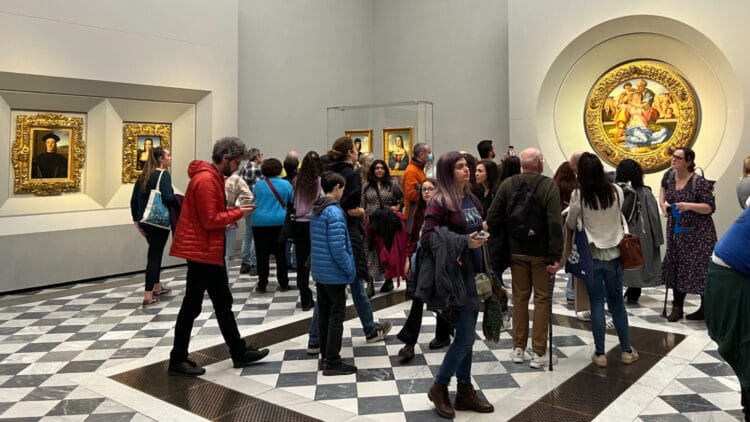
Two works commissioned by a local Florentine power couple, Agnolo Doni and his wife, Maddalena Strozzi, are among the highlights of the Michelangelo and Raphael Room (A38):
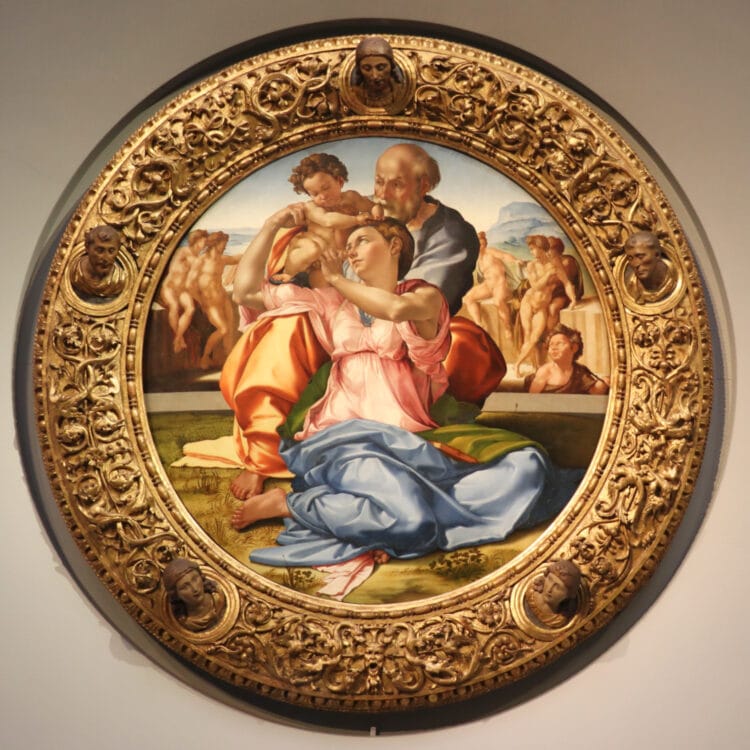
The Holy Family, known as the “Doni Tondo”, 1505-6, is Michelangelo’s only finished panel painting. The powerful figures and vivid colors show Christ with his parents as normal people. The nudes in the background were clearly inspired by classical sculptures.
- Michelangelo also made a notable marble “Pitti Tondo” (Bargello National Museum). Further sculptures by Michelangelo in Florence are in the Accademia (David) and the Medici Chapels.
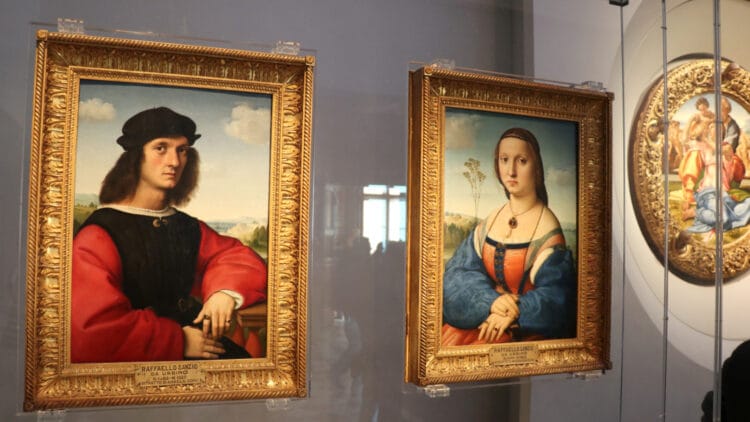
In painting the Portraits of Agnolo and Maddalena Doni, 1504-7, Raffaello Sanzio followed the Flemish style of showing the nobles from the front and side rather than in profile.
Although these portraits are of significant art historical importance, many enjoy Raphael’s other works here more:
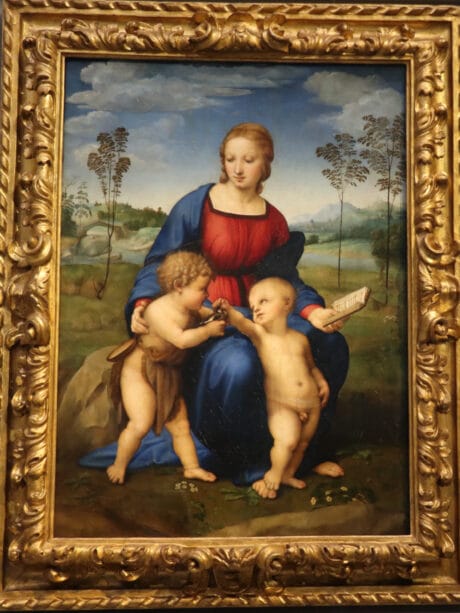
Madonna of the Goldfinch, 1506 – Raphael painted Mary, Christ, and the young John the Baptist in graceful harmony and balance. It is quintessential High Renaissance.
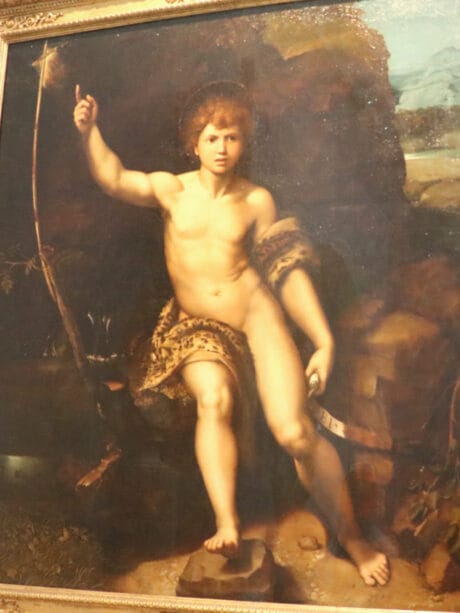
St John the Baptist as a Boy, 1518, was inspired by Leonardo’s work now in the Louvre, as well as the Laocoön (at the end of the corridor).
These key High Renaissance works show the transition to more natural and dynamic compositions compared to the stiff late medieval paintings at the museum entrance.
Titian and the 16th-Century Paintings
The work of artists less closely associated with Florence is now mostly on the first floor of the Uffizi. Many paintings here are of very high quality, but are similar to what may be seen in other museums.
If you still have time, these are the most important later highlights en route to the main exit:
Titian in the Uffizi Gallery in Florence
Beautifully displayed in room D23, a bit off the main route:
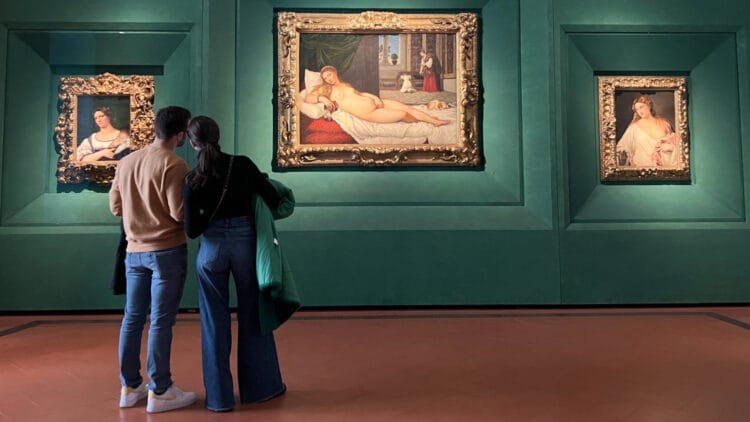
- Venus of Urbino, 1538, by Titian. A sensual and influential Renaissance nude, which served as a prototype for many later works.
- Flora, 1517, by Titian. Soft, luminous beauty in a classic Venetian portrait style.
- La Fornarina, 1512, by Sebastiano del Piombo, was long attributed to Titian, as the sitter was believed to be his mistress.
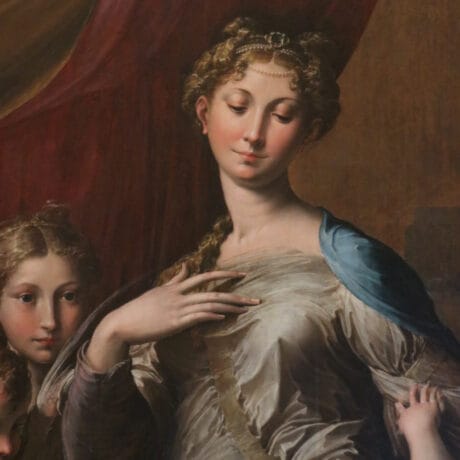
In D4, together with works by Correggio, is the delightful Madonna and Child with Angels (but more commonly known as Madonna with the Long Neck), 1534-40, by Parmigianino. The Madonna is elegant but distorted, a hallmark of Mannerism, and probably taking some inspiration from Michelangelo.
See works by Tintoretto and Veronese in the halls leading back to the exit. (Or see the Venetian artists’ best works in Accademia in Venice.)
Finish: Caravaggio and Baroque Highlights in the Uffizi
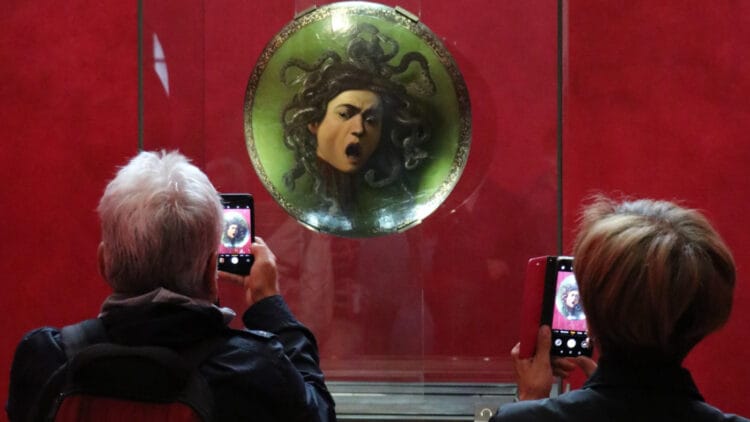
End a visit to the Uffizi with dramatic, emotional works that contrast strongly with earlier Renaissance paintings. Many visitors aim for the exit, but the final, relatively small rooms (E4-7) have Baroque surprises:
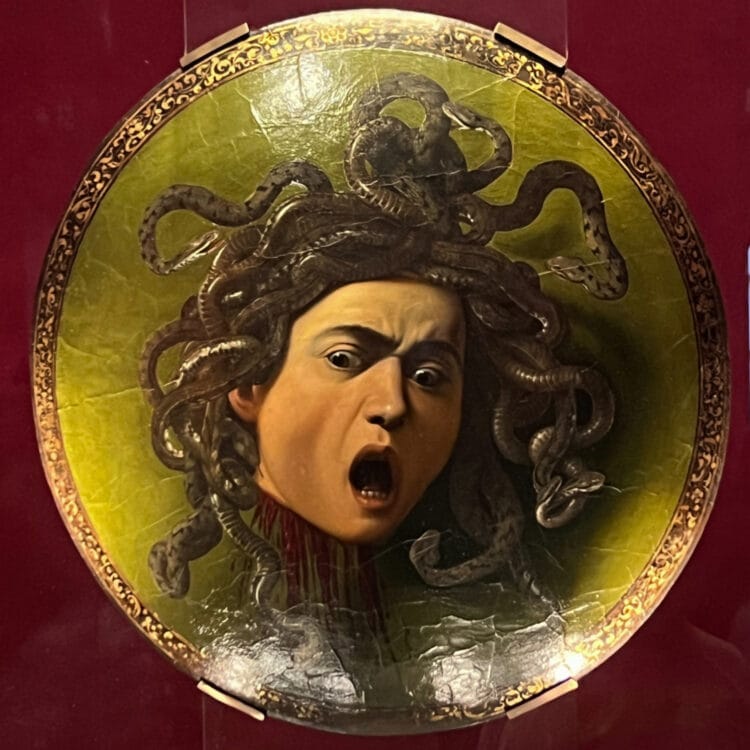
- Medusa – Caravaggio. Painted on a shield—dramatic, terrifying, and unforgettable.
- Sacrifice of Isaac, 1603, is Caravaggio’s take on one of the Bible’s disturbing family traumas.
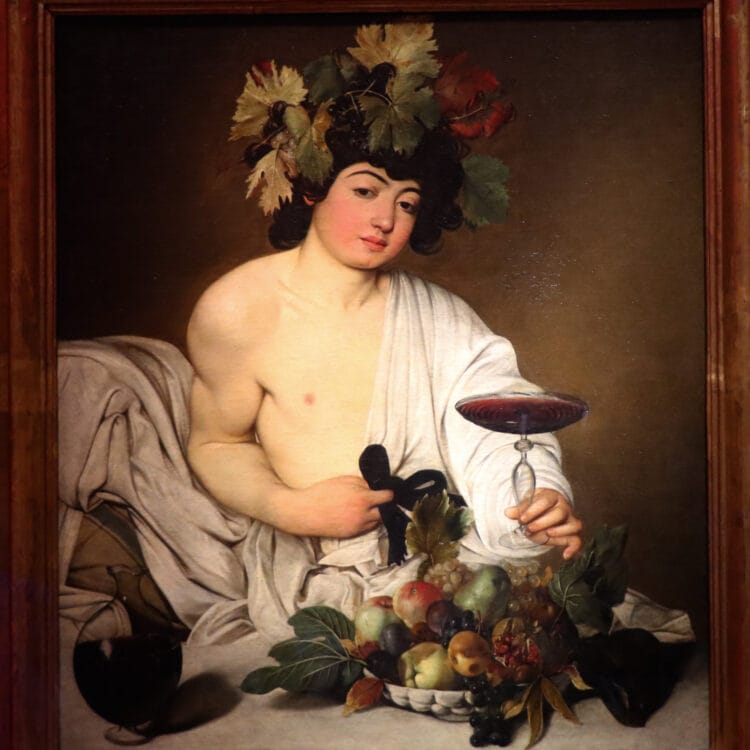
- Bacchus, 1598 – Caravaggio’s sensual, realistic portrayal of the god of wine—note the lifelike details. A reminder that he started his career as a painter of fruit for the tourist market.
- Judith Slaying Holofernes, 1620, by Artemisia Gentileschi, is powerful, dramatic, and intense. One of the most striking Baroque works.
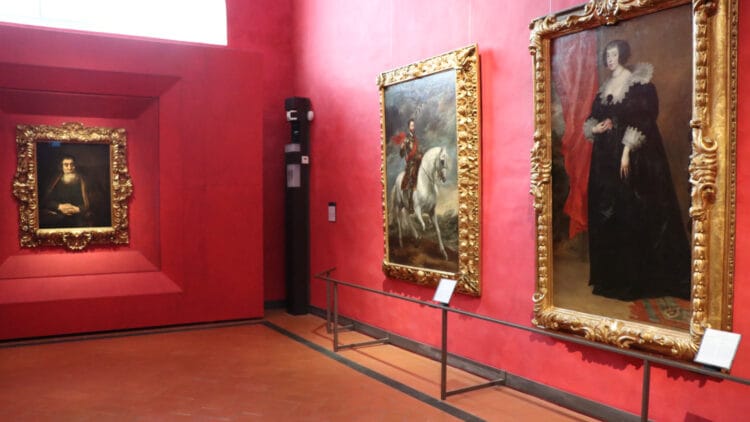
The couple of paintings by Rembrandt, Rubens, and Van Dyck in the final room of the Uffizi are darker in color but peaceful, and may often be enjoyed in private.
This route covers the most famous works in the Uffizi while keeping the visit manageable in about two hours.
The Uffizi is one of the world’s top and most popular museums. However, it is not all that suitable for mass tourism, so tickets frequently sell out. Buy tickets or book tours as early as possible to ensure admission.
Uffizi Visiting Strategy: Book tickets early, use these top visiting tips, follow a 2-hour highlights route, and don’t miss the key sculptures.