The best tips for visiting the Uffizi Gallery in Florence are simple: buy tickets in advance, arrive early in the morning, and see the top artworks first.
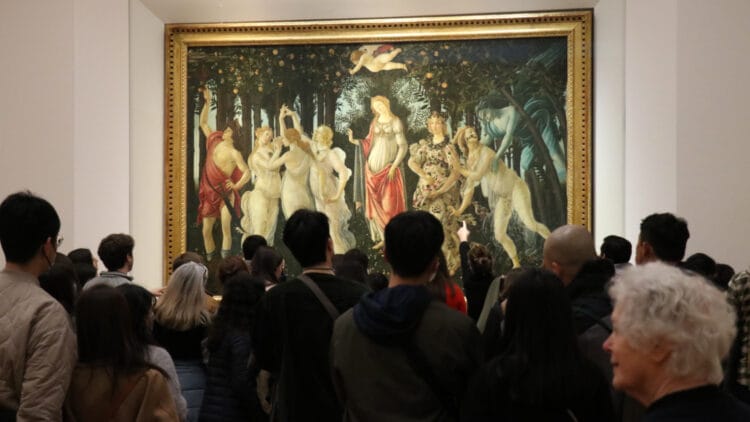
The Uffizi Gallery is one of the top art museums in Italy and the best place in the world to see Renaissance paintings, including Primavera and the Birth of Venus by Botticelli. The museum was not designed for the masses that visit daily, but a few sensible tips can make a big difference between feeling pressganged and actually enjoying the wonderful art on display.
Top tips for a pleasant visit to the Uffizi in Florence include:
- Buy tickets in advance or book tours if preferred.
- Best time to visit: first thing in the morning, or for some, late afternoon.
- Plan the route a bit — rooms with the most popular art get crowded easily.
- Accept that it may be busy — return to a favorite work once a group moves on.
Buying Tickets or Booking Tours for the Uffizi in Florence
The single best tip for visiting the Uffizi Gallery in Florence is to buy a time-slot reservation ticket in advance. The €4 reservation fee (also payable on free and discounted tickets) is money well spent.
Turn up 10 to 5 minutes before the ticket time and enter the Uffizi without delay. Visitors without time-slot reservations may wait in the queue for hours, as priority is always given to timed tickets and tours.
Guided tours are a good option for easy admission and to see the top works with good explanations. Try to book a rare off-peak hours tour that starts before 9:30 or after 15:00, when the museum is quieter.
If buying a ticket in person at the museum without a time slot, try to enter before 9:00 or after 15:00. From 10:00 to 14:00, tour groups may keep the Uffizi too busy to allow in new visitors.
→ See ticket buying tips — €25 standard, €16 after 16:00, €2 EU youth, free under 18.
Tips on the Best Times for Visiting the Uffizi
→ Best time: before 9:00 or after 15:00. Avoid 10:00–15:00.
The best time to visit the Uffizi is the first time slot, early morning at 8:15. Only book the second or third slot if the first slot is already sold out. It is worth getting up early…
Choose Uffizi time slots wisely…
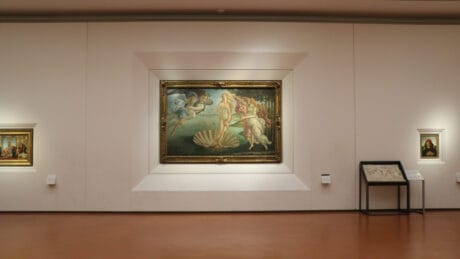
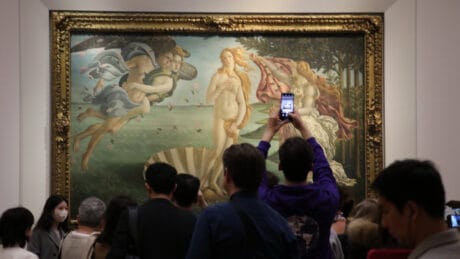
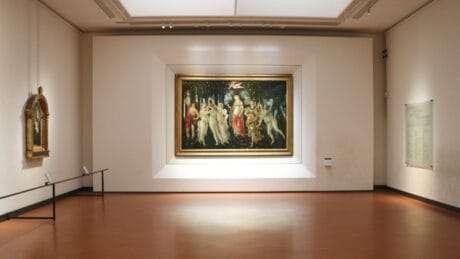
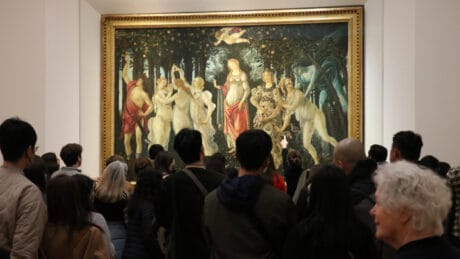
These are the most famous paintings in the Uffizi and are often crowded. If entering the museum early morning, head here immediately. (Both paintings are currently in A9 but should return to A11 and A12 towards the end of 2026.)
The first slot in the morning is the best option for visiting the Uffizi. It doesn’t matter whether you are a one-hour, two-hour, half-day, or might-as-well-get-an-annual-pass museum goer. (Annual passes pay off in about two visits and include immediate access, so a good option to spread art viewing over a couple of days.)
Late afternoon remains the reasonable fallback option for those who really can’t make it first thing in the morning. However, from 2026, entering after 16:00 gives a good discount, so the Uffizi is likely now busier late afternoon than in previous years. Still, late afternoon remains a better option than late morning. (If on a Firenze Card or full-price ticket, entering 15:30 is likely the better time-slot than 16:00 or 16:15.)
The afternoon ticket gives a saving but allows for only around two hours. This is not nearly enough to see all the art, but plenty of museum time for many, and enough for the Uffizi highlights. Grab the savings deal if it works.
The Uffizi is busiest between 10:00 and 15:00, on Tuesdays, weekends, public holidays, and school holidays. Be in before 9:00 (but it is really worth getting up 45 minutes earlier), or enter after 15:00.
Why is late morning the worst time to visit the Uffizi without timed tickets? To enter the museum, others must exit first. Early morning visitors tend to stay more than two hours. From around 10:00, tour groups keep adding more visitors, and they won’t start exiting before noon. Without a reservation, you’d be lucky to enter before lunchtime on a busy day.
Planning a Route through the Uffizi
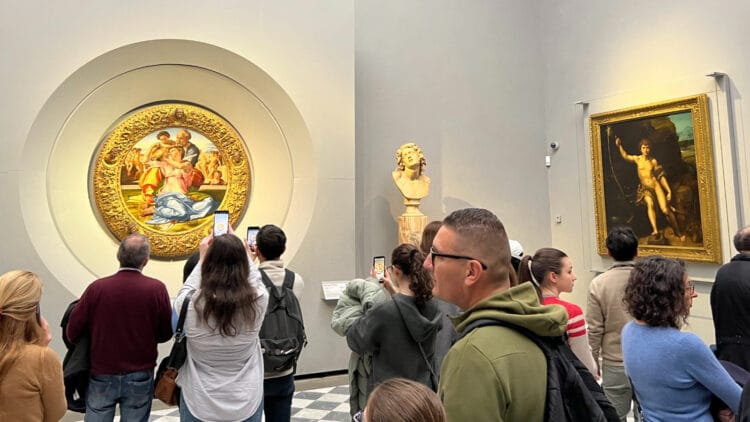
The Uffizi is a large museum with a lot of very good art, but no one can appreciate it all in a single visit. Don’t try to see everything — focus on the highlights.
It is worth studying the map a bit before visiting. (Download the latest Uffizi Map pdf map and check out the art highlights in about 2 hours.)
Top 10 Must-See Artworks in the Uffizi Gallery

If you are short on time, these ten masterpieces are the absolute art highlights of the Uffizi Gallery in Florence:
- The Birth of Venus – Sandro Botticelli
- Primavera – Sandro Botticelli
- Annunciation – Leonardo da Vinci
- Adoration of the Magi – Leonardo da Vinci
- Doni Tondo – Michelangelo
- Madonna of the Goldfinch – Raphael
- Venus of Urbino – Titian
- Madonna with the Long Neck – Parmigianino
- Medusa – Caravaggio
- Venus de’ Medici – Classical Greek sculpture
Start with Botticelli’s rooms, continue through Leonardo and Michelangelo, and look out for the classical sculptures displayed along the corridors before finishing with Caravaggio.
Uffizi Floorplan Layout and Visitor Routes
The Uffizi is in a U-shaped building with the museum galleries spread over two upper floors. Entry, security, audio guides, and the cloak room are on the ground floor. The visitors’ route starts on the top (2nd) floor.
The museum map shows three routes:
- Fast — 1 ½ to 2 hours — only the top floor, i.e., the late Middle Ages and Renaissance (as well as many of the best sculptures from antiquity). These rooms are the highlights of the museum and the art that really makes the Uffizi special. If I had only two hours, I would spend most of my time on this floor.
- Classic — more than two hours — add to the top floor, the large 16th-century collection on the first floor, and the four rooms of the 17th-century paintings.
- Complete — more than three hours — add, in addition to the classic tour, the few rooms of the Contini Bonacossi collection (smaller sculptures), self-portraits, and the early Renaissance.
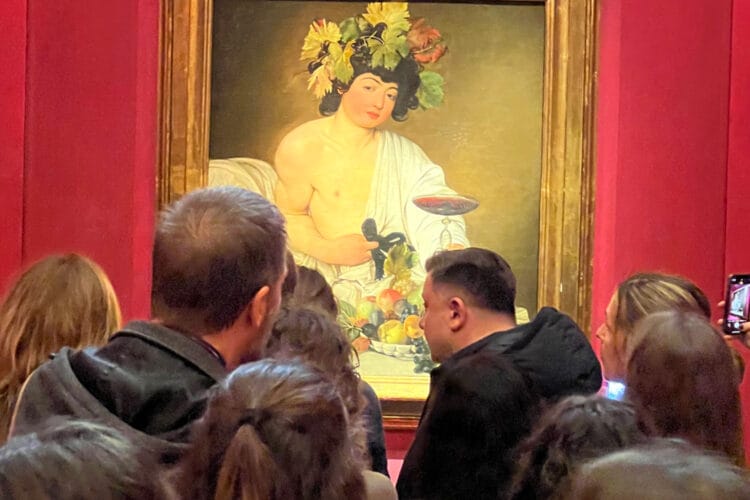
Tip: Don’t miss the four 17th-century painting rooms, it is just before the final stairs leading to the exit (E4-E7). Most visitors have run out of steam by now, so it is often possible to enjoy a private viewing of the paintings (too good for the Pitti Palace?) by Caravaggio (Medusa, Bacchus), Rembrandt, Rubens, and Van Dyck.
Uffizi Strategy Early in the Morning
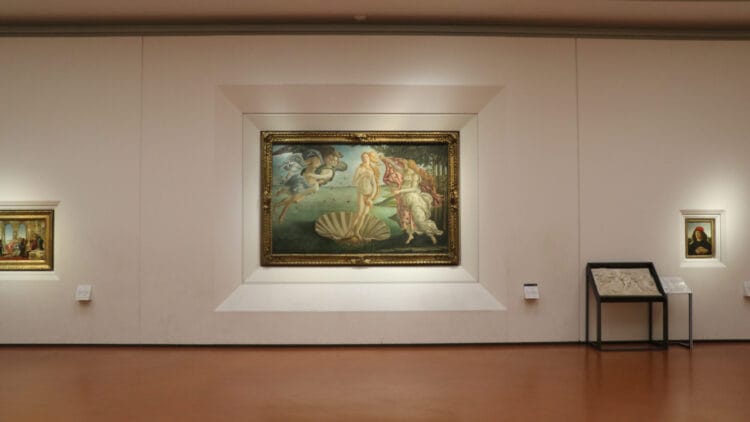
If you are among the first visitors to enter the Uffizi in the morning, don’t waste the opportunity to see the top paintings almost in private.
The museum will fill up fast. Go see the Botticcellis first and then return to the first halls with wonderful late Medieval paintings.
→ The Birth of Venus and Primavera (Spring) are currently in Room A9, but should eventually move back to A11-12.
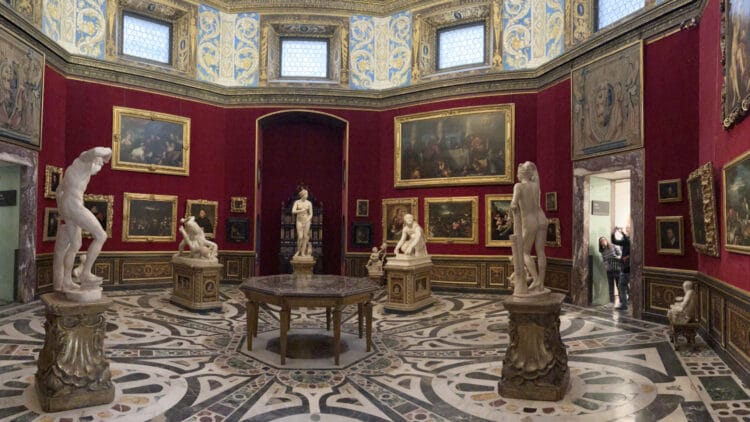
Next, go a few doors down the corridor to the Tribune (A16) to see the best of the sculptures from antiquity, including the Medici Venus, The Wrestlers, and Dancing Satyr (Kroupezeion). The best views are from the corridor door, where a queue will soon form. (The two doors from Halls A15 and A17 are often less crowded.)
The overambitious may gallop ahead around the U at the far end of the gallery to visit the Leonardo da Vinci (A35) and Michelangelo and Raphael (A38) halls in private in the opposite museum wing. However, it is quite a long trek back to the entrance to see all the works missed.
Do visit room A3 at leisure at any time — it is on the “wrong” side of the entrance door and hardly visited at all.
The Uffizi is generally busiest between 10:00 and 15:00 with new groups arriving constantly. There is no point in getting irritated by the groups. Enjoy the other paintings in the hall and eavedrop on the guides — some are excellent. Groups generally move on fast, with a short gap before the next group crowds the paintings.
Uffizi Sculptures and Ceilings
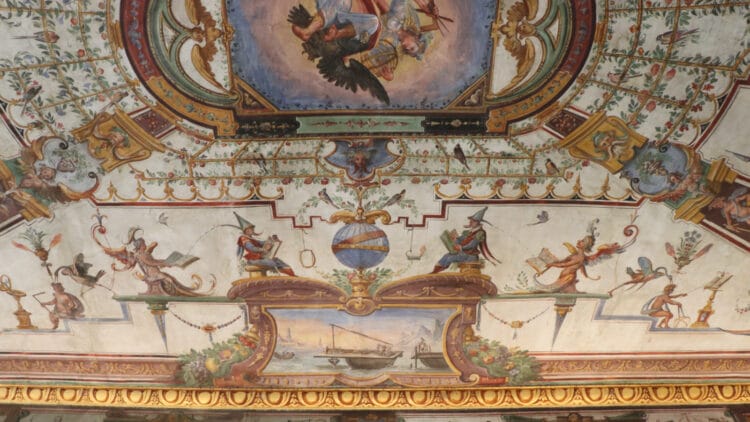
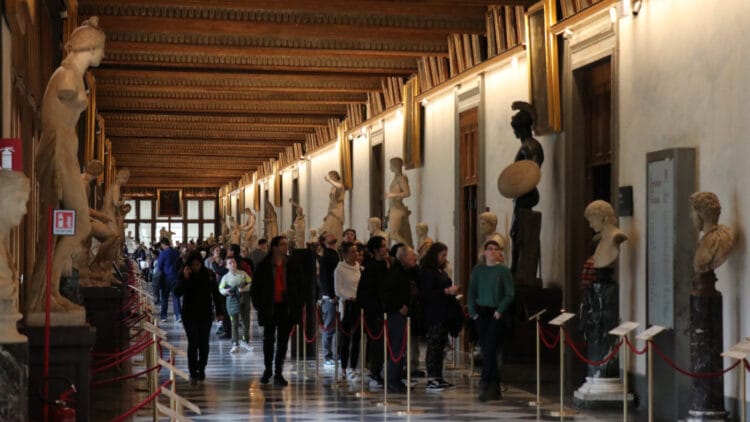
It is impossible to miss the very impressive marble sculptures from antiquity that line the corridors, but many visitors fail to take much note of them. In previous centuries, these marbles were often more praised than the paintings. Many are of exceptional quality.
Do look up — the Medicis certainly loved a good ceiling. No matter how busy the museum is, it is almost impossible for visitors to ruin the views of the spectacularly beautiful and detailed ceilings in the Uffizi. (The Medicis did the same in much of the Pitti Palace and the Palazzo Vecchio.)
Top 5 Sculptures in the Uffizi Gallery
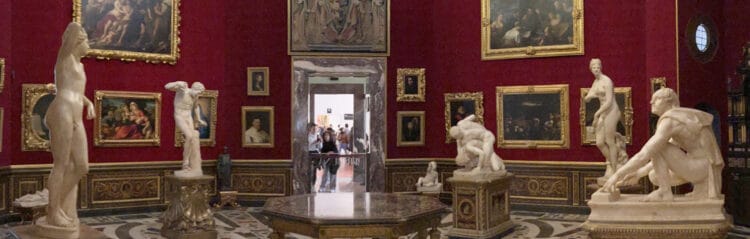
- Medici Venus (Venus de’ Medici) – Classical Hellenic sculpture
- Laocoön and His Sons – Dramatic 16th-century copy of a Greek masterpiece
- Dancing Faun – Lively Hellenistic-style sculpture
- Bust of Antinous – Idealized portrait of Emperor Hadrian’s companion
- Arrotino (The Scythian Slave) – Striking figure in a dynamic pose
Most sculptures are in the Uffizi’s corridors and can be seen easily while moving between the main painting rooms.
Is the Vasari Corridor Worth the Extra Ticket Charge?
Worth it? Only if you are particularly interested — otherwise, skip.
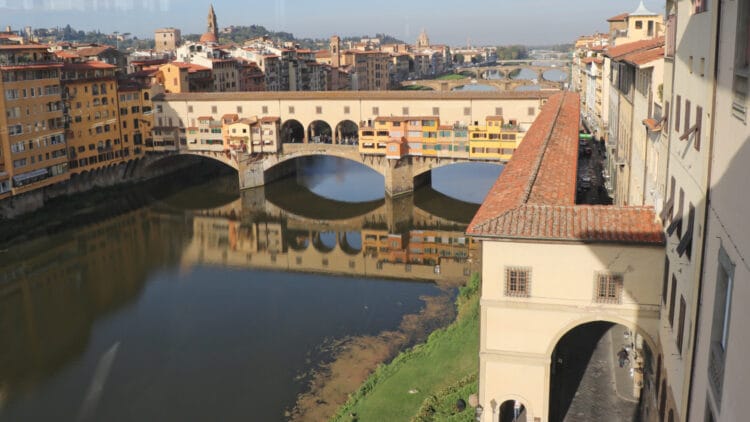
The Vasari Corridor, linking the Uffizi and Pitti Palace, was completed in only six months in 1565. Access to the corridor adds around €20 to any other ticket. Time-slot reservations are essential, but may also be bought onsite if times are available.
Access to the Vasari Corridor is from room D19 on the first floor (16th-century paintings section), with the final exit at the Boboli Gardens. It is one-way with no readmission to the Uffizi, so it is not allowed to use the lockers at security.
You have to be on time for the Vasari Corridor visit — catching up is not possible. A group of around 25 visitors is accompanied on the 1-km (just over half-a-mile) walk by two museum officials. It is not a guided tour — they ensure no one runs ahead or lingers behind. Plan on around 45 minutes from start to exit at the Boboli Gardens (admission not included in the basic ticket).
Is the Vasari Corridor worth the supplement? I walked the corridor many years ago and won’t pay to do it again. Although there are around 800 paintings along the way, these are not the museum’s best, and you are not allowed to linger anyway.
Visitor Facilities at the Uffizi
Although not as massive as the Louvre, the Uffizi offers very few opportunities for taking a break or even quiet rooms away from the main route.
Cafe Restaurant
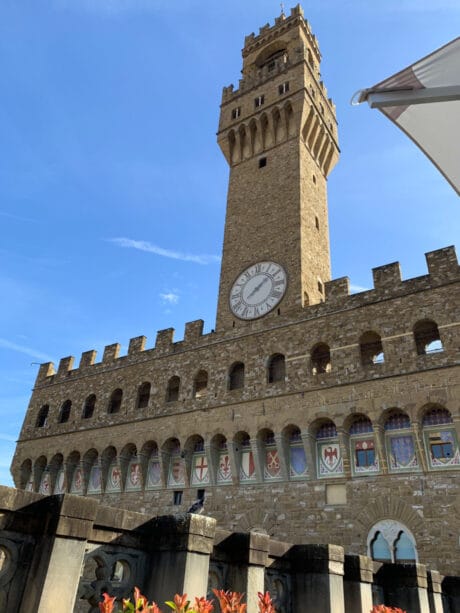
The only cafe at the Uffizi is rather grandly positioned at the far end of the top floor, right above the beautiful Loggia dei Lanzi. It offers grand views of the Palazzo Vecchio. Prices are fairly high, and it gets full very quickly, especially close to lunch time.
A small self-service counter also gives visitors a glance at the piazza, but it is not really very inviting.
Halfway through the Uffizi, it is your only food option in the museum, but if you are close to finishing a visit, much better options are available elsewhere in Florence.
Toilets at the Uffizi
Toilets at the Uffizi are limited to after security on the ground floor, at the end of the top floor near the cafe (Lanzi staircase), and on the first floor near the Buontalenti staircase.
As with the Accademia, the condition of these facilities is often a disgrace. (Judged by the graffiti on the walls, the museum may not be entirely to blame.) Visitors will do well to use the toilets elsewhere.
Uffizi Visiting Strategy: Book tickets early, use these top visiting tips, follow a 2-hour highlights route, and don’t miss the key sculptures.